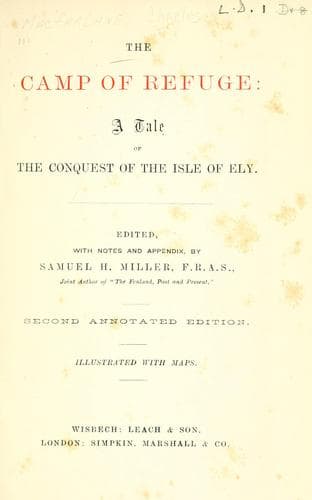
The Camp of Refuge: A Tale of the Conquest of the Isle of ElyMacFarlane, Charles
History
The Camp of Refuge: A Tale of the Conquest of the Isle of Ely
MacFarlane, Charles
Great Britain -- History -- Medieval period, 1066-1485 -- Fiction
Within the moated and battlemented manor-house near to the banks of the
Welland, which Elfric had stopped to gaze upon as he was travelling
from Crowland to Spalding, there was held a feast on the fourth day
after the feast of Saint Edmund, for the said fourth day from the great
Saxon festival was the feast-day of some saint of Normandie or of
Anjou, and the Ladie Lucia, maugre her sorrow and affliction, had given
birth to a male child a moon agone, and the child was to be baptized on
this day with much rejoicing. Ivo Taille-Bois and his Norman retainers
were glad, inasmuch as the birth of a son by a Saxon wife went to
secure them in their possession of the estates; and the Ladie Lucia was
glad of heart, as a mother cannot but rejoice at the birth of her
first-born; and her Saxon servants, and all the old retainers of her
father’s house, and all the Saxon serfs, were glad, because their
future lord would be more than one half Saxon, being native to the
country, a child of the good Ladie Lucia, the daughter of their last
Saxon lord. So merry were all, that grievances seemed to be forgotten:
the Normans ceased to oppress and insult; the Saxons ceased, for the
time being, to complain. The feast was very bountiful, for the Ladie
Lucia had been allowed the ordering of it; and the company was very
numerous and much mixed, for many Saxons of name had been bidden to the
feast, and pledges had been given on both sides that there should be a
truce to all hostilities and animosities; that there should be what the
Normans called the Truce of God until the son of Ivo Taille-Bois and
Lucia, the presumptive heir to all the lands of the old lord, should be
christened, and his christening celebrated in a proper manner. No less
a man than the prelate Lanfranc had interfered in making this salutary
arrangement. And for the first time since the death of her father,
Lanfranc’s fair ward, the Ladie Alftrude, had come forth from her own
manor-house to attend at the earnest invitation of her cousin the Ladie
Lucia. The Saxon heiress had come attended by sundry armed men and by
two aged English priests who stood high in the consideration and favour
of the potent Lanfranc. When, landing from her boat (the country was
now nearly everywhere under water), she walked up to the gate of the
house, and entering, drew aside her wimple and showed her sweet young
face and bright blue eyes, there rose a murmur of admiration from all
that were assembled there: the Saxons vowed in good old English that
the Ladie Alftrude was the fairest and noblest maiden in all England;
and the Normans swore in Norman-French and with many a _Vive Dieu_ that
they had never beheld anything equal to her either on the other side of
the seas or on this! Nay, some of the Norman knights, and more than one
whose beard was growing grey while he was yet in poverty or wholly
unprovided with any English estate, forgot the broad lands that
Alftrude inherited, to think only of her beautiful face. Yet when
Public-domain text, read in full here on John Shaqi.
Reviews
Reviews
No reviews yet
Be the first to share your thoughts on this work.
Join the Discussion
Join the discussion
Sign in to leave a comment or review.
Sign InorCreate an account