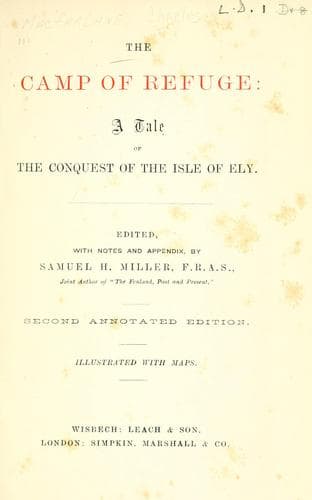
The Camp of Refuge: A Tale of the Conquest of the Isle of ElyMacFarlane, Charles
History
The Camp of Refuge: A Tale of the Conquest of the Isle of Ely
MacFarlane, Charles
Great Britain -- History -- Medieval period, 1066-1485 -- Fiction
it had been for their own profit, they could not be expected to concur
in it, or even to allow it, when it was only for the profit of him and
his brother. Vanity, thy name was Norman! There was young Guiscard[106]
of Avranches, there was tall Etienne[107] of Rouen (and verily a tall
and well-proportioned young man was he, and one that could talk glibly
both in English and in French), there was Baldwin of the Mount, a most
nimble dancer, and with a fine gilded cloak over his shoulders and not
a crown in his purse (even like all the rest of them); there was old
Mainfroy of La Perche, who had followed Robert Guiscard into Italie and
Grecia, and had lost an eye and half of a nose in those wars before
Ladie Alftrude was born; and there was old Drogo[108] from Chinon, who
looked as though he had added to his own nose that half of a nose
Mainfroy had lost (so hugeous and misshapen was Drogo’s nose!); and not
one of these gay knights but thought that the Lady Alftrude having once
seen and heard him must prefer him to all the world. In their own
conceit they were, one and all of them, already Lords of Ey and
husbands of Alftrude. Judge ye then whether Ivo Taille-Bois could have
safely ventured to stay his fair guest against her will, or shut up his
wife’s cousin in close bower for his as yet unknown and unseen brother!
But there was now in the hall a merrier eye, and one more roguish
withal, than ever shone under the brows of a Norman. The drawbridge
being down, and the gate of the house wide open, that all who list
might enter and partake according to his degree of some of the good
things that were provided, a young Saxon glee-man or menestrel came
over the bridge unchallenged, and only paused under the low archway of
the gate. His dress was tattered and torn, and not free from the mud
and slime of the fens, but sweet and clear was his voice, and merry and
right old English his song; and so all the Saxons that heard him gave
him welcome, and bade him enter the hall and sing a lay in honour of
the Ladie Lucia and of her first-born son, who would be good lord to
all Saxon folk as his grandfather had been before him. But before going
into the hall, where the feast was just over, and all the tables
cleared, the glee-man went aside into the buttery to renew his strength
with a good meal, and refresh his voice with a cup of good wine. When
he entered the hall the old Saxon seneschal cried, “A glee-man! another
glee-man come to sing an English song!” The Norman menestrels looked
scornfully at him and his tattered cloak; and the Saxon menestrels
asked of one another who he might be; for none of them knew him, albeit
the menestrels, like the beggars and other happy vagabonds of old
England, were united in league and brotherhood, in sort that every
menestrel of East Anglia was thought to know every other menestrel or
glee-man of that countrie. But when the new and unknown comer had
played his preludium on his Saxon lyre of four strings, and had sung
Public-domain text, read in full here on John Shaqi.
Reviews
Reviews
No reviews yet
Be the first to share your thoughts on this work.
Join the Discussion
Join the discussion
Sign in to leave a comment or review.
Sign InorCreate an account