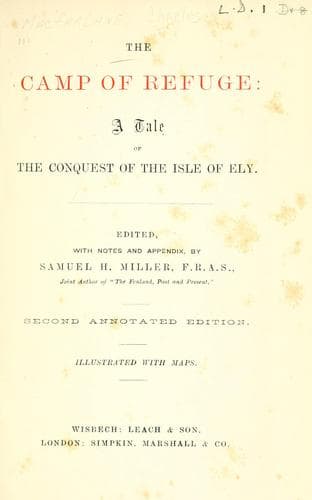
The Camp of Refuge: A Tale of the Conquest of the Isle of ElyMacFarlane, Charles
History
The Camp of Refuge: A Tale of the Conquest of the Isle of Ely
MacFarlane, Charles
Great Britain -- History -- Medieval period, 1066-1485 -- Fiction
As the convent was but a dependency of my Lord Abbat Thurstan, and a
succursal cell to Ely, ye may judge whether the Lord of Brunn and those
who came with him met with hospitality! Saxons and strangers (and all
landed from the barks as soon as might be, and hastened to the convent)
found suppers and beds, or suppers and clean sweet rushes to lie upon,
either with the sub-prior or in the guest-house. In the morning, as
soon as it was light, Hereward, Elfric, and the dark stranger, and a
score of armed men, re-embarked in the good ship that had brought them
to Lynn, and proceeded up the river Ouse, leaving the other four barks
at their moorings under the prior’s wharf. These four craft were to
keep a good look-out, and in case of any armed ships coming into the
Wash they were to run, through the most intricate passage, for
Spalding; but if no enemy should appear (and of this there was scarcely
a chance, as the weather continued stormy, and the Normans were bad
seamen, and very badly provided with shipping), they were all to wait
at Lynn until Lord Hereward should come back from Ely to lead them to
Spalding, and, farther still, to his own house at Brunn.
Broad and free was the river Ouse, and up as high as the junction of
the Stoke[116] Lord Hereward’s bark was favoured by the tide as well as
by the wind. Above the Stoke the tide failed; but the wind blew
steadily on, and many boats, with lusty rowers in them, came down from
Ely and Chettisham and Littleport, and took the bark in tow, for the
signal-lights and fires which had guided the fleet into Lynn had been
carried across the fens and to the Abbey of Ely, and had told my Lord
Abbat that the Lord Hereward was come. No bark had ever made such
voyage before, nor have many made it since; but a good while before the
sun went down our Lynn mariners made their craft fast to my Lord
Abbat’s pier, and Hereward and his bold and trusty followers landed in
the midst of a throng ten times greater and ten times more jubilant
than that which had welcomed them at Lynn. Before quitting the ship
Elfric put on his monastic habit. This he did not do without a sigh;
and he carried with him under his novice’s gown the gay dress he had
worn while in foreign parts and on shipboard. Maybe he expected that
services might be required from him in which such an attire would be
useful; or perhaps he hoped that his superior of Spalding and the Abbat
of Crowland would, in considering the services he had rendered already,
determine in their wisdom that the dress and calling of a monk were not
those which suited him best. Although not bound by any irrevocable vow,
Elfric was bound by the ties of gratitude to Father Adhelm, who had
taken him into the succursal cell at Spalding when a very young and
helpless orphan; and Elfric would never have been the man he proved
himself if he had been forgetful of duties and obligations.
Public-domain text, read in full here on John Shaqi.
Reviews
Reviews
No reviews yet
Be the first to share your thoughts on this work.
Elsewhere in the archive
Join the Discussion
Join the discussion
Sign in to leave a comment or review.
Sign InorCreate an account