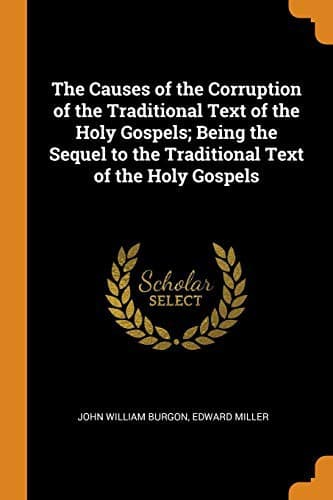
The Causes of the Corruption of the Traditional Text of the Holy Gospels: Being the Sequel to The Traditional Text of the Holy GospelsBurgon, John William
Religion
The Causes of the Corruption of the Traditional Text of the Holy Gospels: Being the Sequel to The Traditional Text of the Holy Gospels
Burgon, John William
Bible. Gospels -- Criticism, Textual
Now it happens that all the Uncials but six and an immense majority of
the Cursive copies contain the words before us:--that besides these, the
Old Latin, the Syriac, the Vulgate, the Gothic and the Bohairic
versions, all concur in exhibiting them:--that the same words are
expressly recognized by the Sectional System of Eusebius;--having a
section ([Greek: sis] / [Greek: e] i.e. 216/8) to themselves--which is
the weightiest sanction that Father had it in his power to give to words
of Scripture. So are they also recognized by the Syriac sectional system
(260/8), which is diverse from that of Eusebius and independent of it.
What then is to be set against such a weight of ancient evidence? The
fact that the following six Codexes are without this 28th verse,
[Symbol: Aleph]ABCDX, together with the Sahidic and Lewis. The notorious
Codex k (Bobiensis) is the only other ancient testimony producible; to
which Tischendorf adds 'about forty-five cursive copies.' Will it be
seriously pretended that this evidence for omitting ver. 28 from St.
Mark's Gospel can compete with the evidence for retaining it?
Let it not be once more insinuated that we set numbers before antiquity.
Codex D is of the sixth century; Cod. X not older than the ninth: and
not one of the four Codexes which remain is so old, within perhaps two
centuries, as either the Old Latin or the Peshitto versions. We have
Eusebius and Jerome's Vulgate as witnesses on the same side, besides the
Gothic version, which represents a Codex probably as old as either. To
these witnesses must be added Victor of Antioch, who commented on St.
Mark's Gospel before either A or C were written[163].
It will be not unreasonably asked by those who have learned to regard
whatever is found in B or [Symbol: Aleph] as oracular,--'But is it
credible that on a point like this such authorities as [Symbol:
Aleph]ABCD should all be in error?'
It is not only credible, I answer, but a circumstance of which we meet
with so many undeniable examples that it ceases to be even a matter of
surprise. On the other hand, what is to be thought of the credibility
that on a point like this all the ancient versions (except the Sahidic)
should have conspired to mislead mankind? And further, on what
intelligible principle is the consent of all the other uncials, and the
whole mass of cursives, to be explained, if this verse of Scripture be
indeed spurious?
I know that the rejoinder will be as follows:--'Yes, but if the ten
words in dispute really are part of the inspired verity, how is their
absence from the earliest Codexes to be accounted for?' Now it happens
that for once I am able to assign the reason. But I do so under protest,
for I insist that to point out the source of the mistakes in our oldest
Codexes is no part of a critic's business. It would not only prove an
endless, but also a hopeless task. This time, however, I am able to
explain.
Public-domain text, read in full here on John Shaqi.
Reviews
Reviews
No reviews yet
Be the first to share your thoughts on this work.
Join the Discussion
Join the discussion
Sign in to leave a comment or review.
Sign InorCreate an account