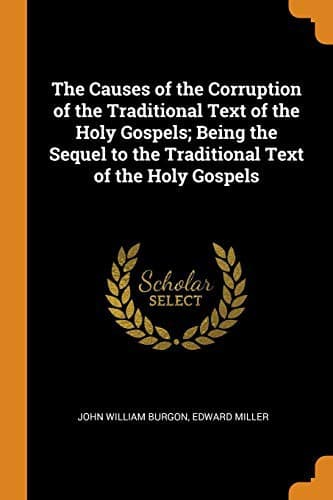
The Causes of the Corruption of the Traditional Text of the Holy Gospels: Being the Sequel to The Traditional Text of the Holy GospelsBurgon, John William
Religion
The Causes of the Corruption of the Traditional Text of the Holy Gospels: Being the Sequel to The Traditional Text of the Holy Gospels
Burgon, John William
Bible. Gospels -- Criticism, Textual
One and the same reply has been rendered to this inquiry ever since the
days of Erasmus. A note in the Complutensian Polyglott (1514) expresses
it with sufficient accuracy. 'In the Greek copies, after _And deliver us
from evil_, follows _For thine is the kingdom, and the power, and the
glory, for ever_. But it is to be noted that in the Greek liturgy, after
the choir has said _And deliver us from evil_, it is the Priest who
responds as above: and those words, according to the Greeks, the priest
alone may pronounce. This makes it probable that the words in question
are no integral part of the Lord's Prayer: but that certain copyists
inserted them in error, supposing, from their use in the liturgy, that
they formed part of the text.' In other words, they represent that men's
ears had grown so fatally familiar with this formula from its habitual
use in the liturgy, that at last they assumed it to be part and parcel
of the Lord's Prayer. The same statement has been repeated ad nauseam by
ten generations of critics for 360 years. The words with which our
Saviour closed His pattern prayer are accordingly rejected as an
interpolation resulting from the liturgical practice of the primitive
Church. And this slipshod account of the matter is universally
acquiesced in by learned and unlearned readers alike at the present day.
From an examination of above fifty ancient oriental liturgies, it is
found then that though the utmost variety prevails among them, yet that
_not one_ of them exhibits the evangelical formula as it stands in St.
Matt. vi. 13; while in some instances the divergences of expression are
even extraordinary. Subjoined is what may perhaps be regarded as the
typical eucharistic formula, derived from the liturgy which passes as
Chrysostom's. Precisely the same form recurs in the office which is
called after the name of Basil: and it is essentially reproduced by
Gregory of Nyssa, Cyril of Jerusalem, and pseudo-Caesarius; while
something very like it is found to have been in use in more of the
Churches of the East.
'_For thine is the kingdom, and the power, and the glory_, Father, Son
and Holy Ghost, now and always and _for ever_ and ever. _Amen_.'
But as every one sees at a glance, such a formula as the
foregoing,--with its ever-varying terminology of praise,--its constant
reference to the blessed Trinity,--its habitual [Greek: nun kai
aei],--and its invariable [Greek: eis tous aionas ton aionon], (which
must needs be of very high antiquity, for it is mentioned by
Irenaeus[170], and may be as old as 2 Tim. iv. 18 itself;)--the
doxology, I say, which formed part of the Church's liturgy, though
transcribed 10,000 times, could never by possibility have resulted in
the unvarying doxology found in MSS. of St. Matt. vi. 13,--'_For thine
is the kingdom, and the power, and the glory, for ever. Amen._'
Public-domain text, read in full here on John Shaqi.
Reviews
Reviews
No reviews yet
Be the first to share your thoughts on this work.
Elsewhere in the archive
Join the Discussion
Join the discussion
Sign in to leave a comment or review.
Sign InorCreate an account