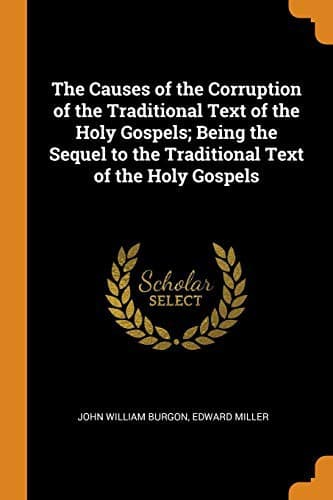
The Causes of the Corruption of the Traditional Text of the Holy Gospels: Being the Sequel to The Traditional Text of the Holy GospelsBurgon, John William
Religion
The Causes of the Corruption of the Traditional Text of the Holy Gospels: Being the Sequel to The Traditional Text of the Holy Gospels
Burgon, John William
Bible. Gospels -- Criticism, Textual
The sum of what has been offered may be thus briefly stated:--The
textual perturbation observable at St. Matt. vi. 13 is indeed due to a
liturgical cause, as the critics suppose. But then it is found that not
the great bulk of the Evangelia, but only Codd. [Symbol: Aleph]BDZ, 1,
17, 118, 130, 209, have been victims of the corrupting influence. As
usual, I say, it is the few, not the many copies, which have been led
astray. Let the doxology at the end of the Lord's Prayer be therefore
allowed to retain its place in the text without further molestation. Let
no profane hands be any more laid on these fifteen precious words of the
Lord Jesus Christ.
There yet remains something to be said on the same subject for the
edification of studious readers; to whom the succeeding words are
specially commended. They are requested to keep their attention
sustained, until they have read what immediately follows.
The history of the rejection of these words is in a high degree
instructive. It dates from 1514, when the Complutensian editors, whilst
admitting that the words were found in their Greek copies, banished them
from the text solely in deference to the Latin version. In a marginal
annotation they started the hypothesis that the doxology is a liturgical
interpolation. But how is that possible, seeing that the doxology is
commented on by Chrysostom? 'We presume,' they say, 'that this
corruption of the original text must date from an antecedent period.'
The same adverse sentence, supported by the same hypothesis, was
reaffirmed by Erasmus, and on the same grounds; but in his edition of
the N.T. he suffered the doxology to stand. As the years have rolled
out, and Codexes DBZ[Symbol: Aleph] have successively come to light,
critics have waxed bolder and bolder in giving their verdict. First,
Grotius, Hammond, Walton; then Mill and Grabe; next Bengel, Wetstein,
Griesbach; lastly Scholz, Lachmann, Tischendorf, Tregelles, Alford,
Westcott and Hort, and the Revisers have denounced the precious words as
spurious.
Public-domain text, read in full here on John Shaqi.
Reviews
Reviews
No reviews yet
Be the first to share your thoughts on this work.
Elsewhere in the archive
Join the Discussion
Join the discussion
Sign in to leave a comment or review.
Sign InorCreate an account