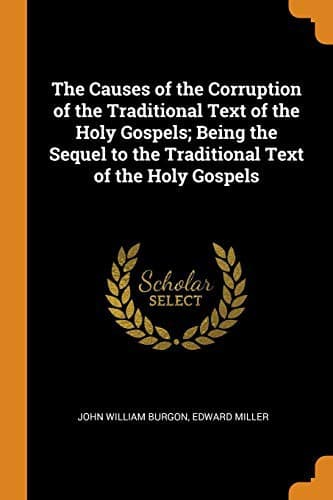
The Causes of the Corruption of the Traditional Text of the Holy Gospels: Being the Sequel to The Traditional Text of the Holy GospelsBurgon, John William
Religion
The Causes of the Corruption of the Traditional Text of the Holy Gospels: Being the Sequel to The Traditional Text of the Holy Gospels
Burgon, John William
Bible. Gospels -- Criticism, Textual
Nor is any one at liberty to appeal to a yet earlier period than is
attainable by existing liturgical evidence; and to suggest that then the
doxology used by the priest may have been the same with that which is
found in the ordinary text of St. Matthew's Gospel. This may have been
the case or it may not. Meanwhile, the hypothesis, which fell to the
ground when the statement on which it rested was disproved, is not now
to be built up again on a mere conjecture. But if the fact could be
ascertained,--and I am not at all concerned to deny that such a thing is
possible,--I should regard it only as confirmatory of the genuineness of
the doxology. For why should the liturgical employment of the last
fifteen words of the Lord's Prayer be thought to cast discredit on their
genuineness? In the meantime, the undoubted fact, that for an
indefinitely remote period the Lord's Prayer was not publicly recited by
the people further than 'But deliver us from evil,'--a doxology of some
sort being invariably added, but pronounced by the priest alone,--this
clearly ascertained fact is fully sufficient to account for a phenomenon
so ordinary [found indeed so commonly throughout St. Matthew, to say
nothing of occurrences in the other Gospels] as really not to require
particular explanation, viz. the omission of the last half of St.
Matthew vi. 13 from Codexes [Symbol: Aleph]BDZ.
FOOTNOTES:
[145] [I have retained this passage notwithstanding the objections made
in some quarters against similar passages in the companion volume,
because I think them neither valid, nor creditable to high intelligence,
or to due reverence.]
[146] [The Textual student will remember that besides the Lectionaries
of the Gospels mentioned here, of which about 1000 are known, there are
some 300 more of the Acts and Epistles, called by the name Apostolos.]
[147] ['It seems also a singular note of antiquity that the Sabbath and
the Sunday succeeding it do as it were cohere, and bear one appellation;
so that the week takes its name--_not_ from the Sunday with which it
commences, but--from the Saturday-and-Sunday with which it concludes.'
Twelve Verses, p. 194, where more particulars are given.]
[148] [For the contents of these Tables, see Scrivener's Plain
Introduction, 4th edition, vol. i. pp. 80-89.]
[149] See Scrivener's Plain Introduction, 4th edition, vol. i. pp.
56-65.
[150] Twelve Verses, p. 220. The MS. stops in the middle of a sentence.
[151] St. Luke xxii. 43, 44.
[152] In the absence of materials supplied by the Dean upon what was his
own special subject, I have thought best to extract the above sentences
from the Twelve Last Verses, p. 207. The next illustration is his own,
though in my words.
[153] i. 311.
[154] [Greek: eipen ho Kyrios tois heautou mathetais; me tarassestho.]
[155] [Greek: kai eipen tois mathetais autou]. The same Codex (D) also
prefixes to St. Luke xvi. 19 the Ecclesiastical formula--[Greek: eipen
de kai eteran parabolen].
Public-domain text, read in full here on John Shaqi.
Reviews
Reviews
No reviews yet
Be the first to share your thoughts on this work.
Elsewhere in the archive
Join the Discussion
Join the discussion
Sign in to leave a comment or review.
Sign InorCreate an account