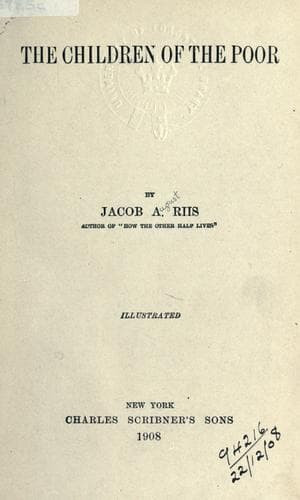
The Children of the PoorRiis, Jacob A. (Jacob August)
History
The Children of the Poor
Riis, Jacob A. (Jacob August)
Child welfare -- New York (State) -- New York; Poor; Poor -- New York (State) -- New York
This unconquerable vanity, if not turned to use for his good, makes a
tough of the lad with more muscle than brains in a perfectly natural way.
The newspapers tickle it by recording the exploits of his gang with
embellishments that fall in exactly with his tastes. Idleness encourages
it. The home exercises no restraint. Parental authority is lost. At a
certain age young men of all social grades know a heap more than their
fathers, or think they do. The young tough has some apparent reason for
thinking that way. He has likely learned to read. The old man has not; he
probably never learned anything, not even to speak the language that his
son knows without being taught. He thinks him "dead slow," of course, and
lays it to his foreign birth. All foreigners are "slow." The father works
hard. The boy thinks he knows a better plan. The old man has lost his grip
on the lad, if he ever had any. That is the reason why the tough appears
in the second generation and disappears in the third. By that time father
and son are again on equal terms, whatever those terms may be. The
exception to this rule is in the poorest Irish settlements where the
manufacture of the tough goes right on, aided by the "inflooence" of the
police court on one side and the saloon on the other. Between the two the
police fall unwillingly into line. I was in the East Thirty-fifth Street
police station one night when an officer came in with two young toughs
whom he had arrested in a lumber yard where they were smoking and
drinking. They had threatened to kill him and the watchman, and loaded
revolvers were taken from them. In spite of this evidence against them,
the Justice in the police court discharged them on the following morning
with a scowl at the officer, and they were both jeering at him before
noon. Naturally he let them alone after that. It was one case of hundreds
of like character. The politician, of course, is behind them. Toughs have
votes just as they have brickbats and brass-knuckles; when the emergency
requires, an assortment to suit of the one as of the other.
The story of the tough's career I told in "How the Other Half Lives," and
there is no need of repeating it here. Its end is generally lurid, always
dramatic. It is that even when it comes to him "with his boots off," in a
peaceful sick bed. In his bravado one can sometimes catch a glimpse of the
sturdiest traits in the Celtic nature, burlesqued and caricatured by the
tenement. One who had been a cut-throat, bruiser, and prizefighter all his
brief life lay dying from consumption in his Fourth Ward tenement not long
ago. He had made what he proudly called a stand-up fight against the
disease until now the end had come and he had at last to give up.
"Maggie," he said, turning to his wife with eyes growing dim, "Mag! I had
an iron heart, but now it is broke. Watch me die!" And Mag told it proudly
at the wake as proof that Pat died game.
Public-domain text, read in full here on John Shaqi.
Reviews
Reviews
No reviews yet
Be the first to share your thoughts on this work.
Join the Discussion
Join the discussion
Sign in to leave a comment or review.
Sign InorCreate an account