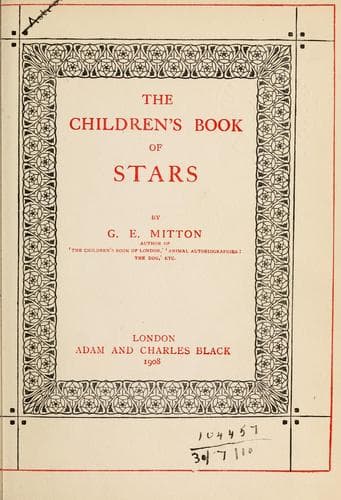
The Children's Book of StarsMitton, G. E. (Geraldine Edith)
Science
The Children's Book of Stars
Mitton, G. E. (Geraldine Edith)
Astronomy -- Juvenile literature
There is nothing very striking about Jupiter's orbit. He takes between
eleven and twelve of our years to get round the sun, so you see, though
his day is shorter, his year is longer than ours. And this is not only
because his path is much larger, but because by the law of gravity the
more distant a planet is from the sun the more slowly it travels, so
that while the earth speeds over eighteen miles Jupiter has only done
eight. Of course, we must be careful to remember the difference between
rotation and revolution. Jupiter rotates much quicker than the
earth--that is to say, he turns round more quickly--but he actually gets
over the ground more slowly. The sun appears much smaller to him than it
does to us, and he receives considerably less light and heat. There are
various spots on his surface, and one remarkable feature is a dark mark,
which is called the 'great red spot.' If as we suppose what we see of
the planet is merely the cloudy upper atmosphere, we should not expect
to find anything permanent there, for the markings would change from day
to day, and this they do with this exception--that this spot, dark red
in colour, has been seen for many years, turning as the planet turned.
It was first noticed in 1878, and was supposed to be some great mountain
or excrescence peeping up through the clouds. It grew stronger and
darker for several years, and then seemed to fade, and was not so easily
seen, and though still remaining it is now pale. But, most startling
to say, it has shifted its position a little--that is, it takes a few
seconds longer to get round the planet than it did at first. A few
seconds, you will say, but that is nothing! It does not seem much, but
it shows how marvellously accurate astronomers are. Discoveries of vast
importance have been made from observing a few seconds' discrepancy in
the time the heavenly bodies take in their journeys, and the fact that
this spot takes a little longer in its rotation than it did at first
shows that it cannot be attached to the body of the planet. It is
impossible for it to be the summit of a mountain or anything of that
sort. What can it be? No one has yet answered that question.
[Illustration: JUPITER AND ONE OF HIS MOONS]
When we get to the chapter on the sun, we shall find curiosities
respecting the spots there as well.
Public-domain text, read in full here on John Shaqi.
Reviews
Reviews
No reviews yet
Be the first to share your thoughts on this work.
Join the Discussion
Join the discussion
Sign in to leave a comment or review.
Sign InorCreate an account