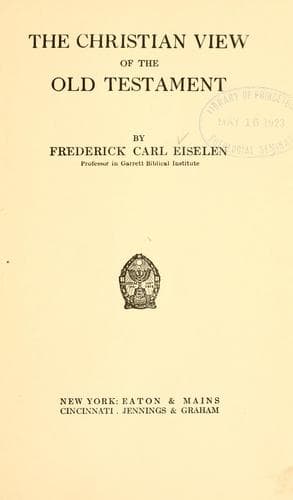
The Christian View of the Old TestamentEiselen, Frederick Carl
Religion
The Christian View of the Old Testament
Eiselen, Frederick Carl
Bible. Old Testament -- Criticism, interpretation, etc.
Many hold that in his references to Old Testament books Jesus
accommodated himself to the usage of the Jews without indorsing their
views or giving expression to his own, even though he knew that the
commonly held opinions as to the authorship of certain Old Testament
books were erroneous. Those who advocate this view believe that their
attitude in no wise dishonors the Master. Indeed, they say, one cannot
easily see what other course he could have taken. Jesus had come to
reveal the Father, to bring a fallen race into harmony with a holy God.
Surely, the task was great, and there was but little time in which to
accomplish it. If he had turned aside from his chief purpose to settle
scientific and literary questions which were not under discussion among
the people, he would have aroused popular {96} opposition and thus have
hindered his chief work. In no case do his references imply that he
desired to pronounce an authoritative critical judgment, and in no case
does the value of the quotation depend upon its authorship. Looking at
the matter, therefore, from a pedagogical standpoint, it would seem
that, in view of his important mission in the world, he was compelled
to accommodate himself to the views of the people in all matters not
essential to his work.
This view seems entirely satisfactory to many sincere Christian
believers. There are, however, those who maintain that it would not
have been legitimate for Jesus thus to accommodate himself to the usage
of the people if he had known that their views were not in accord with
the facts; nevertheless, they insist that his utterances do not settle
purely literary questions. They believe that Jesus shared the views of
the people, that he actually thought that Moses wrote the entire
Pentateuch, and Isaiah, the whole of the book bearing his name; but
that this was a limitation of knowledge on his part. And they further
insist that this attitude toward Jesus in no wise affects the supreme
and final authority of the Christ over the lives of men. The entire
life of the Master, they say, shows that he regarded his mission as
spiritual; he did not come to correct all errors, but merely those
touching religion and {97} ethics; and even here he did not give
detailed specific rules. In many cases he simply laid down great
principles, which in time might be worked out and applied to the
details of human activity. He did not abolish slavery, he made no
efforts to correct errors in science; why should he correct erroneous
views respecting literary and critical questions? These were outside
of his immediate sphere of interest. His knowledge or ignorance in
these secondary matters does not necessarily involve his knowledge or
authority in essentials.[26] Again, while Christ was God, he was also
truly man. This union of the divine with the human, if real, must have
brought some limitations. And the New Testament clearly teaches that
in some respects the powers of Christ were limited.
Public-domain text, read in full here on John Shaqi.
Reviews
Reviews
No reviews yet
Be the first to share your thoughts on this work.
Join the Discussion
Join the discussion
Sign in to leave a comment or review.
Sign InorCreate an account