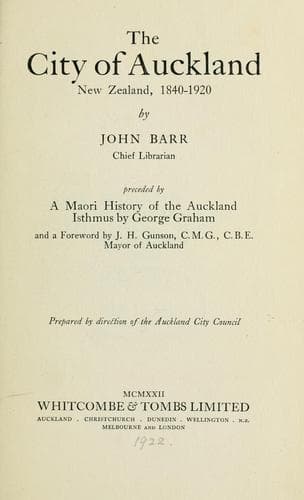
The City of Auckland, New Zealand, 1840-1920Barr, John
History
The City of Auckland, New Zealand, 1840-1920
Barr, John
Auckland (N.Z.) -- History
The year 1854 also saw the establishment of a regular inter-provincial
steamer service. The _Nelson_ (330 tons, Captain Martin) was the
pioneer vessel, Dunedin and Onehunga being the terminal ports, and New
Plymouth, Nelson, Wellington and Lyttelton ports of call. In 1855 the
_Zingari_ (150 tons, Captain Milltown) replaced the _Nelson_. Other
steamers engaged during this period on the coastal routes were the
_Claud Hamilton_ and the _White Swan_, which was wrecked on June 29th,
1862, a number of public records belonging to the Government being lost.
The Inter-Colonial R.M.S. Company met with opposition in the coastal
service from the New Zealand Steam Navigation Company, which had been
formed upon the liquidation of the Wellington Steamship Company, in
1863, the following steamers being used in the running of the service,
_viz_, _Stormbird_, _Wellington_ and _Queen_.
Another line which traded between Dunedin and Auckland was the
Adelaide, Melbourne and Otago S.N. Company, which placed the
_Alhambra_ (642 tons) and _Aldinga_ (446 tons) on this run.
The wreck of H.M.S. _Orpheus_ on the Manukau Bar on February 7th, 1863,
was the most appalling disaster associated with Auckland's shipping
annals. The _Orpheus_ (Commodore W. F. Burnett) was a corvette of 1706
tons, which had been detailed for service on the New Zealand station.
She sailed from Sydney on January 31st, and reached the Manukau Heads
on 7th February. In attempting to cross the bar the vessel "struck
hard, and orders were given to back astern full speed. The engines
never moved; the ship fell off broadside to the rollers, the sea
knocking away her stern post, port bulwarks and boats, and making a
clean sweep over all." A cutter containing the ship's records, and a
pinnace got safely away. After the pinnace had left the ship, "the
launch was got over the side with forty men to lay out anchors, in the
hope of making grapplings to haul into smooth water. The ebb-tide,
unhappily, swept her under the bows, where she was stove, and nearly
all on board drowned." The pinnace, however, was able to get into
touch with the steamer _Wonga Wonga_, and later with H.M.S. _Harrier_,
and the few survivors from the wreck were picked up by the former
vessel. About 6.30 p.m. the masts went, and the ship parted in halves.
A contemporary account of the disaster states that the officers and men
underwent the terrible ordeal in heroic fashion, and "when the masts
went the crew gave three cheers, as if taking farewell of life." Out
of a ship's company of 256 officers, seamen, boys and marines, only 71
survived. The remains of some of the crew, including the commodore,
which were washed ashore, were interred in Symonds Street cemetery. The
disaster created consternation in the city, and a day of mourning was
observed in memory of those who lost their lives.
Public-domain text, read in full here on John Shaqi.
Reviews
Reviews
No reviews yet
Be the first to share your thoughts on this work.
Join the Discussion
Join the discussion
Sign in to leave a comment or review.
Sign InorCreate an account