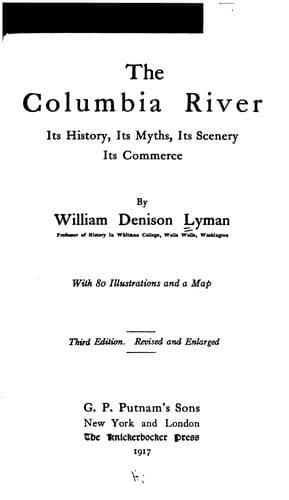
The Columbia River: Its History, Its Myths, Its Scenery, Its CommerceLyman, William Denison
History
The Columbia River: Its History, Its Myths, Its Scenery, Its Commerce
Lyman, William Denison
Columbia River; Columbia River -- Description and travel; Columbia River -- History
In recent times the idea that here some chest, with gold and jewels in
the most approved style of buried fortunes, might be found has caused much
searching. The ground has been dug over for the sight of the regulation
rusty handle which is to lead to the great iron-bound chest with its
doubloons of gold and crucifixes of pearls. Parties have come from the
Eastern States to join the search. One party even secured the guidance of
spirits who professed to locate the treasure. But though the spirit-led
enthusiasts turned over every stone and dug up the sand for many feet
along the beach, they found never an iron-bound chest, and never a sign of
the treasure. There is, however, in plain sight now, on a rock at the foot
of Nekahni Mountain, a character cut in the rock bearing a rude
resemblance to a cross. Some think it looks more like the letters, I.H.S.,
the sacred emblem of the Catholic Church. There is also what seems to be
quite a distinct arrow pointing in a certain direction. But the treasure
remains unfound.
The next legend of the prehistoric white man is that of the "Beeswax
Ship." This, too, has a real confirmation in the presence of large
quantities of beeswax at a point also near Nekahni Mountain, just north of
the mouth of the Nehalem River. Some naturalists claimed at one time that
this substance was simply the natural paraffine produced from the products
of coal or petroleum. But more recently cakes of the substance stamped
with the sacred letters, "I.H.S.," together with tapers, and even one
piece with a bee plainly visible within, may be considered incontestable
proof that this is indeed beeswax, while the letters, "I.H.S." denote
plainly enough the origin of the substance in some Spanish colony. An
interesting point in connection with this is the historical fact that on
June 16, 1769, the ship _San Jose_ left La Paz, Lower California, for San
Diego, and was never heard from again. Some have conjectured that the _San
Jose_ was the "Beeswax Ship," driven far north by some storm or mutiny. As
to the peculiar fact that a ship should have been entirely loaded with
beeswax it has been conjectured that some of the good padres of the
Spanish Missions meant to provide a new station with a large amount of wax
for the sake of providing tapers for their service, the lighted candles
proving then, as they do now, a matter of marvel and wonder to the
natives, and, with other features of ceremonial worship, having a great
effect to bring them into subjection to the Church.
Public-domain text, read in full here on John Shaqi.
Reviews
Reviews
No reviews yet
Be the first to share your thoughts on this work.
Join the Discussion
Join the discussion
Sign in to leave a comment or review.
Sign InorCreate an account