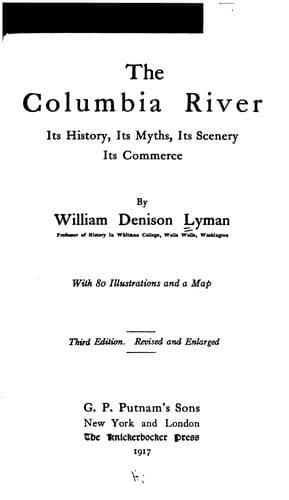
The Columbia River: Its History, Its Myths, Its Scenery, Its CommerceLyman, William Denison
History
The Columbia River: Its History, Its Myths, Its Scenery, Its Commerce
Lyman, William Denison
Columbia River; Columbia River -- Description and travel; Columbia River -- History
The Indian legend runs on to the effect that several white men were saved
from the wreck of the "Beeswax Ship," and that they lived with them. But
having infringed upon the family rights of the natives, they became
obnoxious, and were all cut off by an attack from them. One story,
however, asserts that there was one man left, a blue-eyed, golden-haired
man, that he took a Nehalem woman, and that from him was descended a
fair-complexioned progeny, of which a certain chieftain who lived at a
beautiful little lake on Clatsop plains, now known as Culliby Lake, was
our Quiaculliby.
Such in brief survey, are some of the stories which preserve the record of
the space betwixt the Indian age of myth and the period of authentic
discovery.
CHAPTER III
How all Nations Sought the River from the Sea and how they Found it
Search for Gold--Economic Effects--Early Extension of Exploration
Westward--Cortez--Magellan--Aguilar--Fables of the Sea--Shakspere and
Swift--Maps--Great Wars of the Seventeenth Century and Downfall of
Spain--Long Delay--Resumption of Exploration--Spanish Settlement of
California--Russia and
Behring--Perez--Heceta--Cook--Fur-trade--Gathering of Nations--The
Yankees--Gray and Kendrick--Meares and Vancouver--The Complete
Discovery--Strife between England and the United States.
The period of the Renaissance is one, which by reason of splendid
achievements in literature, in art, in science, and in discovery, can
hardly be duplicated. We are here especially concerned with the
discoverers. A mingling of motives impelled those dauntless spirits
onward, and among the most potent was the greed for gold. Much American
history is bound up with the mad rush for the precious metals, and the
spread of exploration from the West Indies and Mexico, the first centres
of Spanish power, was one of its results. Only eight years after the
landing of Columbus on San Salvador, the Portuguese Gaspar Cortereal had
conceived the idea of a north-west passage, which in some unexplained
manner became known as the Strait of Anian. In 1543, the Spaniards
Cabrillo and Ferrelo coasted along the shores of California, and the
latter was doubtless the first white man to look upon the coast of Oregon.
In 1577, England appeared in the person of that boldest and most
picturesque of the half-discoverers, half-pirates, of that time, Francis
Drake. In that year he set forth on the wonderful voyage in which he
plundered the treasures of the Spanish Main, cut the golden girdle of
Manila, queen of the Spanish Orient, skirted along the coast of California
and Oregon, and at last circumnavigated the globe. Brilliant as were
Drake's exploits, they did not result in the discovery of our Great River.
In 1592, just a century after Columbus, Juan de Fuca, whose name is now
preserved in the strait leading to Puget Sound, is said to have made that
voyage which is regarded by most historians as a myth, but which affords
Public-domain text, read in full here on John Shaqi.
Reviews
Reviews
No reviews yet
Be the first to share your thoughts on this work.
Join the Discussion
Join the discussion
Sign in to leave a comment or review.
Sign InorCreate an account