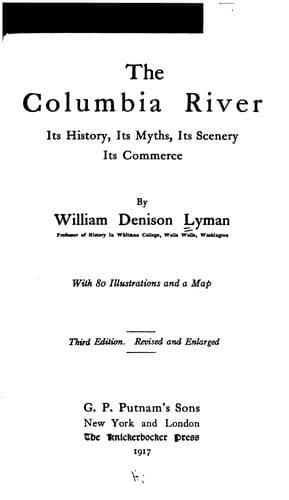
The Columbia River: Its History, Its Myths, Its Scenery, Its CommerceLyman, William Denison
History
The Columbia River: Its History, Its Myths, Its Scenery, Its Commerce
Lyman, William Denison
Columbia River; Columbia River -- Description and travel; Columbia River -- History
But Meares, finding that the Portuguese had special privileges in the
fur-trade and in the harbour of Nootka, entered into an arrangement with
some Portuguese traders whereby he went nominally as supercargo, but
really as captain of the _Felice_, under the Portuguese flag. With her
sailed the _Iphigenia_ with William Douglas occupying a place similar to
that of Meares. In estimating the subsequent pretensions of Great Britain,
the student of history may well remember that these two mariners, though
Englishmen, were sailing under the flag of Portugal.
Reaching again the coast of Oregon, Meares looked in, June 29, 1788, at
the broad entrance of an extensive strait which he believed to be the
mythical Strait of Juan de Fuca of two centuries earlier, but which he did
not pause to explore. He had resolved to solve the riddle of the Rio San
Roque or the Ensenada de Asuncion or de Heceta, and turned his prow
southward. On July 5th, in latitude 46 degrees 10 minutes, he perceived a
deep bay which he considered at once to be the object of his search.
Essaying to enter, he found the water shoaling with dangerous rapidity and
a prodigious easterly swell breaking on the shore. From the masthead it
seemed that the breakers extended clear across the entrance. With rather
curious timidity for a bold Briton right on the eve of a discovery for
which all nations had been looking, Meares lost courage and hauled out,
attaching the name Deception Bay to the inlet and Cape Disappointment to
the northern promontory, the last a name still officially used.
Meares left as his final conclusion in the matter, the following
memorandum: "We can now assert that there is no such river as that of St.
Roc exists, as laid down in the Spanish charts." In view of this statement
of the case it would certainly seem that he could not be accepted as a
witness for English discovery, even if the Portuguese flag had not been
flying at his masthead.
After bestowing the name of Lookout upon the great headland christened
Cape Falcon by Heceta and known to us as Tillamook Head, Meares squared
away for Nootka, and there he spent a very profitable season in the
fur-trade.
But into the harbour of Nootka that same year of 1788, there sailed the
ship of destiny, the _Columbia Rediviva_, in command of John Kendrick.
With the _Columbia_ came the _Lady Washington_, commanded by Robert Gray.
These were the advance guard of Yankee ships which the energies of our
liberated forefathers were sending forth as an earnest of the coming
conquest of Oregon by the universal Yankee nation.
Public-domain text, read in full here on John Shaqi.
Reviews
Reviews
No reviews yet
Be the first to share your thoughts on this work.
Elsewhere in the archive
Join the Discussion
Join the discussion
Sign in to leave a comment or review.
Sign InorCreate an account