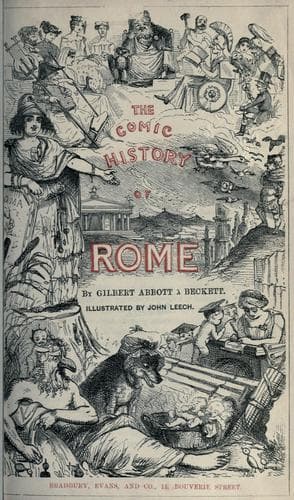
The Comic History of RomeÀ Beckett, Gilbert Abbott
History
The Comic History of Rome
À Beckett, Gilbert Abbott
Rome -- History -- Humor; Wit and humor, Pictorial
The individual thus assailed was rapidly despatched, but it turned out
that the victim, instead of being the king, was an unfortunate scribe,
or writer, who could have been by no means prepared for this unusual
fate of genius. Had the critics unmercifully cut him up, the scribe
would have felt that his death was, to a certain extent, in the way of
business; but to be murdered by mistake for a king, was a result that
any member of the republic of letters might fairly have objected to. It
may appear at first sight startling that a literary man should have been
well-dressed, and in the company of a king, but it must be remembered
that the scribe was not necessarily a man of remarkable ability. His art
was that of a mere copyist, which, even in these days, frequently gains
a reputation for the imitator, who is often confounded with, instead of
being confounded by the man of original genius. The scribes of
antiquity, like many modern writers, did no more than set down the
thoughts of others, and, as their style was extremely hard, consisting
of a piece of iron, with which they wrote upon wax, their works were not
likely to make a very deep or lasting impression.
Our pity for the unfortunate literary character is considerably lessened
by the fact, that being in the camp he had no doubt been dining with the
guards; and we know he was wearing a showy dress--two circumstances
indicating an affectation of the manners of the fast man, which are
always unbecoming to the man of letters.
Mucius was about to retire after the execution of the deed, but he was
seized by the attendants, and then seized by remorse when he was
informed that he had despatched a harmless literary man instead of
Porsenna. Being taken to the king, Mucius found him sitting before the
fire of a large altar. The Etruscan chief, on hearing the charge,
pointed out the penalty that had been incurred, when the prisoner,
thrusting his right hand into the fire, allowed it to remain, with
extraordinary coolness, or, rather, with most intense heat, until it was
consumed as far as the wrist; and he concluded the act of self
incendiarism, by declaring there were three hundred others who were just
as ready as himself to take up arms and burn off a hand, in defiance of
their oppressor. Porsenna, who had watched the painful process with
extreme interest, was so delighted at the fortitude displayed, that he
jumped from his seat, and mentally remarking that "the fellow was a
wonderfully cool hand at an operation of the kind," ordered some guards
to conduct him in safety to Rome; at the same time advising Mucius to
conduct himself more wisely for the future.
[Illustration: Mucius Scævola before Porsenna.]
Mucius returned to Rome, where he obtained the name of Scævola (from
_Scærus_) in consequence of his being left-handed, or it might have been
because of his having evinced such an utter want of dexterity in the
business he had undertaken.
Public-domain text, read in full here on John Shaqi.
Reviews
Reviews
No reviews yet
Be the first to share your thoughts on this work.
Join the Discussion
Join the discussion
Sign in to leave a comment or review.
Sign InorCreate an account