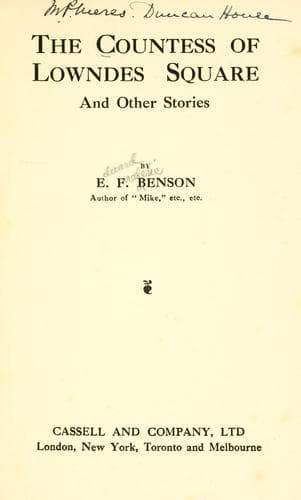
The Countess of Lowndes Square, and Other StoriesBenson, E. F. (Edward Frederic)
General
The Countess of Lowndes Square, and Other Stories
Benson, E. F. (Edward Frederic)
English fiction -- 20th century; Short stories, English
It is better to describe than to let the reader imagine for himself the
state into which Mrs. Withers was brought during these days, because the
imagination from excess of excited fancy would go wildly astray. For she
did not grow one atom distraught or deranged; she became on the contrary
more concentrated and businesslike than ever. She telephoned daily to
Agnes and me to know whether Robbie--she always spoke of him now as
Robbie--had got back from the Continent, and told us quite firmly that
she would put off any other engagement in order to receive him at her
house, or meet him at any other house.
But pending that consummation she remained as regular and as resonant as
a cuckoo-clock, and struck her social hours with the same fluty
regularity. She did not lose her appetite, or take to cocaine or
opium-smoking or drown herself in the Thames, as imagination might
expect, but kept her head, went up several times in an aeroplane in
order to get used to it in case Robbie on his return suggested an
expedition, and temporarily stole my copy of the Cologne sonnets.
I am not quite sure about this, but I missed them one afternoon when she
had been having tea with me, and found next day that in my absence she
had called and gone into my sitting-room to write a note to me. On my
return I found the note prominently displayed, and the Cologne sonnets
concealed in the blotting-book which I had unsuccessfully searched the
evening before. The case is not proved against her, but certainly after
that she could quote from the Cologne sonnets....
Then one morning, even while I was wondering what made Agnes keep Robbie
so long on the Continent, I was rung up by her maid, and asked to go
round to her at once. In answer to a further inquiry, “It’s about Mr.
Oriole, sir.”
Full of some nameless apprehension, I started instantly on that bright
June morning, feeling sure that at the least Robbie was the victim of
some catastrophe. I was even prepared to learn that Robbie was dead,
though I could not form the slightest conjecture as to what had led to
this sudden demise. Or was Robbie engaged to be married, and had we to
arrange about an elusive female of mysterious charm and antecedents?...
Well, it was not that, but it was even worse, for Agnes was engaged to
John Marrible, who, with the selfishness of his sex, insisted that
Robbie should die. He was with her and put his case. Agnes really seemed
more taken up with Robbie than she was with him, and he demanded her
undivided affection. For her part, she wanted to leave Robbie on the
Continent for future emergencies, and promised not to think about him,
but John objected to that. His head, he told us with a glance at her,
was too full of other things, and he could not trust himself not to give
the whole affair away by some inadvertence of happiness and pride. That
glance settled it; Agnes took a half sheet of paper and wrote on it for
a few minutes in silence.
Public-domain text, read in full here on John Shaqi.
Reviews
Reviews
No reviews yet
Be the first to share your thoughts on this work.
Join the Discussion
Join the discussion
Sign in to leave a comment or review.
Sign InorCreate an account