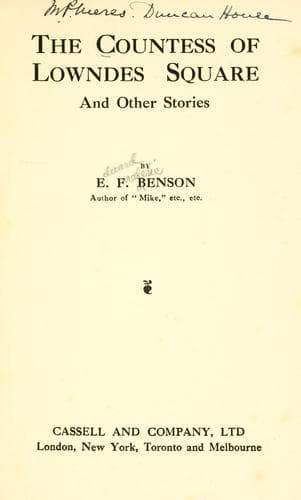
The Countess of Lowndes Square, and Other StoriesBenson, E. F. (Edward Frederic)
General
The Countess of Lowndes Square, and Other Stories
Benson, E. F. (Edward Frederic)
English fiction -- 20th century; Short stories, English
The discerning reader will easily have perceived by this time that both
John Marrible and I were but wax in the inventive hands of Agnes, and
flowed into the shapes that her swift fingers ordained for us.
Occasionally we suggested little curves and decorations of our own,
which she might or might not permit; but we had no independent will in
the matter of Robert Oriole. She was the architect who built this
splendid temple to an imaginary deity in whose honour Mrs. Withers, his
deluded worshipper, swung unregarded censers of asparagus and salmon; at
the most we were the cognisant choir and the organ....
During the next weeks which included the Sunday, Tuesday and Wednesday,
on which Mrs. Withers’s hospitality hungered for Robbie, the number of
Oriolists greatly increased, and this secret society became positively
masonic in clandestine fervour and fidelity. I could see at a glance,
without grips of any kind, whether some friend or acquaintance who
inquired after Robbie was a mason or not, for there was a gleeful
solemnity about the initiated Oriolist which the profane crowd lacked.
There were many who now spoke of him, for Mrs. Withers in her frenzied
efforts to capture him and show him at her house, asked everyone she met
if he knew Robbie, and her large circle of uninitiated guests and
acquaintances grew almost as excited about him as she. Those who knew,
the initiates to whom these mysteries had been unveiled, answered
casually enough when they were applied to by Mrs. Withers, but with that
gleeful solemnity which revealed them to each other.
One morning Robbie would have been “stunting” over Richmond, or had
lunched at the Ritz, or had been swimming in the Serpentine before
breakfast, dropping in unexpectedly to entrance Agnes with the
Brahms-Handel variations, or flying back to the Lakes in the afternoon,
and the telephone messages that passed between the houses of the
initiated were cryptic and yet comprehended utterances. Then on an
ever-memorable day two type-written copies of the Cologne sonnets
circulated among the elect, and were secretly read in corners to the
less fortunate.
On another day, Robbie must have called on me when I was out, for I
found his card with his address, “Blaythwaite Fell,” upon it, when I
returned. He was not able to go to Mrs. Withers’s house either on
Sunday, Tuesday or Wednesday, but on Friday when she returned from a
concert at which Royalty was present, she found a similar card with
Agnes’s on her table, and all the account her parlour-maid could give
was that Miss Lockett had come to the door with “another gentleman” whom
she had not seen before, for Lord Marrible had not previously come to
the house.
Mrs. Withers, trembling with chagrin (for she had not been presented to
Royalty at the concert, and had missed so much more by not stopping at
home) telephoned to Agnes at once, only to learn that Robbie had that
moment left by air for the Continent.
Public-domain text, read in full here on John Shaqi.
Reviews
Reviews
No reviews yet
Be the first to share your thoughts on this work.
Join the Discussion
Join the discussion
Sign in to leave a comment or review.
Sign InorCreate an account