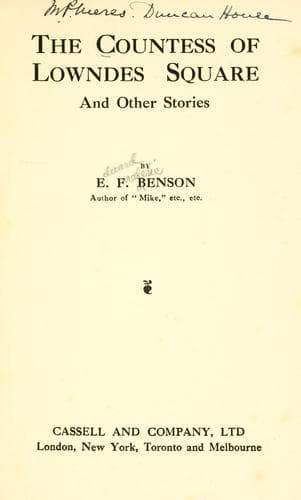
The Countess of Lowndes Square, and Other StoriesBenson, E. F. (Edward Frederic)
General
The Countess of Lowndes Square, and Other Stories
Benson, E. F. (Edward Frederic)
English fiction -- 20th century; Short stories, English
Then from within came the rattle of a turned door-handle, and Case knew
that the death-chamber stood open. There followed a pause of absolute
stillness, in which Case felt utterly detached from and irresponsible
for whatever might follow. Then came the jar of a closed door....
And that tore him screaming from his murderous dreams, from which,
perhaps, he had awoke too late. He found himself, with no volition of
his own, running down the veranda and calling at the top of his voice:
“Percy, Percy,” he cried, “come out. There is a cobra on your bed!”
He heard the handle rattle and the door bang. Next moment he was on his
knees in the dark lobby, clasping Oldham’s legs in a torrent of
hysterical sobbing.
THE FALSE STEP
Mrs. Arthur Bolney Ross, when, three years ago, she set sail, or,
rather, set screw, for England, had no very clear idea of the campaign
she intended to wage there, though a firm determination to win it, and
had mentally arrived at no general plan beyond those preliminary
manœuvres which our charming American invaders usually adopt when they
first effect a landing on the primitive pavements of Piccadilly. She
had, in fact, taken half a dozen rooms at the Ritz Hotel and a box on
the grand tier of the Covent Garden Opera House. But she had also, for
the six months preceding her expedition, secretly received daily lessons
on the pronunciation and idioms of that particular (and, as she thought,
peculiar) dialect of the English language which was in vogue among the
section of the English-speaking race with whom she intended to have
dealings.
Rightly or wrongly, she had decided that the screaming drawl of New
York, which a few years before had so captivated the English upper
classes, and had led to so many charming and successful marriages, was
now out of date, and would enchant no longer. So instead of being
content with her expressive native speech, she learned with almost
passionate assiduity the mumbling English diction, the inaudible
Victorian voice, which she rightly considered would be a novelty to
those who had so largely abandoned it themselves in favour of a more
strident utterance. But she did not, in mastering the Victorian voice
and intonation, suffer her knowledge of her native tongue and its
blatant delivery to wither from misuse; she but became bi-lingual, and
schooled her vocal cords to either register without in the least
confusing the two.
Public-domain text, read in full here on John Shaqi.
Reviews
Reviews
No reviews yet
Be the first to share your thoughts on this work.
Elsewhere in the archive
Join the Discussion
Join the discussion
Sign in to leave a comment or review.
Sign InorCreate an account