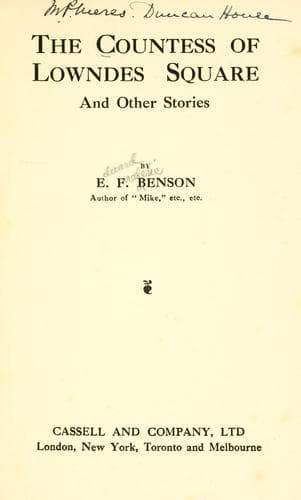
The Countess of Lowndes Square, and Other StoriesBenson, E. F. (Edward Frederic)
General
The Countess of Lowndes Square, and Other Stories
Benson, E. F. (Edward Frederic)
English fiction -- 20th century; Short stories, English
The point to be decided, of course, was which of the two could give the
most ludicrous, extravagant, and delirious parties, and thus be
acclaimed sovereign among hostesses. Amelie, as challenger, had flung
the gauntlet in the shape of a midnight lawn-tennis party, with hundreds
of arc lamps hung above the courts, the nets covered with spangles, and
the lines made of ground glass faintly illuminated by electric lights
beneath, while, by way of contrast with this brilliance, a number of men
dressed like mourners at a funeral, with top-hats and black scarves,
picked up and presented the lawn-tennis balls to her guests in
coffin-shaped trays. Here was a high bid for supremacy, and it was felt
that Mrs. Cicero B. Dace would have to do something great in order to
eclipse the brightness and originality of this entertainment. But bright
and original she was, and when, two nights later, she gave her
marvellous canary ball, it was thought that her throne had not yet
tottered. On this occasion her admiring guests were thrilled to find
that all round the walls of her ballroom had been planted mimosa trees,
among the branches of which three thousand canaries had been let loose,
after being doped with hard-boiled egg soaked in rum and water. These
chirped and sang in a feverish and intoxicated manner. At the end of the
ball the men of the party, dressed as huntsmen and armed with air-guns,
shot these unfortunate songsters and presented the spoils to their
partners in the cotillion.
Amelie had two answers to that--the first an indignant letter, printed
in large type throughout the American press, denouncing this massacre,
and the second another ball. The letter Mrs. Cicero B. Dace did not
object to at all, since it but enhanced her notoriety, but she objected
to the ball very much indeed, since Amelie’s ingenious mind hit on the
simple and exquisite plan of dispensing with the band, and having in its
place a choir of three hundred singers, who, in batches of one hundred
at a time, sang the dance tunes. The effect was contagious, and dancers
joined in also, producing, as the press said, the “most stupendously
lyrical effect since the days of Sappho.”
Public-domain text, read in full here on John Shaqi.
Reviews
Reviews
No reviews yet
Be the first to share your thoughts on this work.
Elsewhere in the archive
Join the Discussion
Join the discussion
Sign in to leave a comment or review.
Sign InorCreate an account