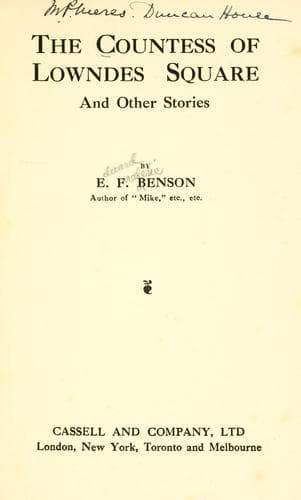
The Countess of Lowndes Square, and Other StoriesBenson, E. F. (Edward Frederic)
General
The Countess of Lowndes Square, and Other Stories
Benson, E. F. (Edward Frederic)
English fiction -- 20th century; Short stories, English
“No, I don’t think it will,” she said. “It is lovely, but you want
something more arresting. You, with your wonderful complexion, can stand
anything. Orange, now--haven’t you got a hit-in-the-face of orange? I
want everybody to be forced to look at you, and you’ll do the rest. You
see I have made myself as plain and inconspicuous as possible, to act as
a foil. It is noble of me, but then I am noble. And all the pearls,
please, just all the pearls, with the big diamond fender on your head.
To-morrow, at the French Embassy, you shall wear the simplest gown you
have got, and one moonstone brooch, price three-and-sixpence.”
* * * * *
Such was the opening of Amelie’s amazing campaign, the incidents and
successes of which followed swift and bewildering. Under Violet’s
capable guidance she began, not by collecting round her that brisk and
hungry section of well-born London which is always ready to sing for its
dinner, and by giving huge entertainments to bring together a crowd at
all costs, but by attracting and attaching a small band of the people
who mattered. Lady Brackenbury knew very well that even in the most
democratic town in the world certain people, not necessarily Princes or
Prime Ministers, were large pieces in the great haphazard game of chess;
the crowd meantime, after whom Amelie secretly hankered, would only get
more eager to be admitted. In particular, Lady Creighton starved for her
entry. She asked Amelie to dine any Tuesday in June, when she was giving
her series of musical parties, but Amelie found, to her great regret,
that she was engaged on all those festive occasions. But she gave a
musical party herself--London was prey this year to a disordered
illusion that it liked music--and Melba and Caruso sang
there--informally, so it seemed, just happening to sing--to not more
than fifty people, who sat in armchairs at their ease, instead of
elbowing each other in squashed and upright rows. In vain did Lady
Creighton spread an assiduous report that the artists had sung out of
tune and that the peaches were sour. Everyone knew that she had not been
there, and that she alluded to another sort of fruit. Violet Brackenbury
was successful in persuading Amelie not to send any account of this
brilliant little affair to the papers, and to refuse all scraps to the
writers for the press. But she was careful to provide for a far more
telling publicity.
Public-domain text, read in full here on John Shaqi.
Reviews
Reviews
No reviews yet
Be the first to share your thoughts on this work.
Elsewhere in the archive
Join the Discussion
Join the discussion
Sign in to leave a comment or review.
Sign InorCreate an account