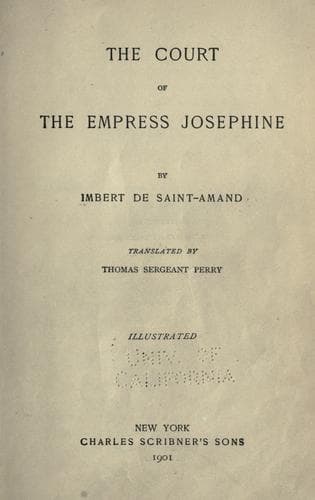
The Court of the Empress JosephineImbert de Saint-Amand
History
The Court of the Empress Josephine
Imbert de Saint-Amand
Josephine, Empress, consort of Napoleon I, Emperor of the French, 1763-1814
There were two distinct elements in the Emperor's household: the military,
and the aristocratic. Some men owed their position entirely to their
merit; others entirely to their birth; these were both patriots of 1792
and emigres, but it must be confessed the Imperial Almanack shows that the
aristocratic element was the more prominent. Napoleon, though certain
writers persist in representing him as the crowned champion of democracy
and the emperor of the lower classes, had a more aristocratic court than
Louis XVIII. He was more impressed by great manners than were the old
kings. Even after he had been betrayed, abandoned, denied, insulted by the
aristocracy, he had a weakness for it. In 1816 he said: "The democracy may
become furious; it has a heart; it can be moved. The aristocracy always
remains cold and never pardons." Yet even after this, he blamed himself
for not having done enough for the French nobility. "I see clearly," he
went on, "that I did either too much or too little for the Faubourg Saint
Germain. I did enough to make the opposition dissatisfied, and not enough
to win it to my side. I ought to have secured the emigres when they
returned. The aristocracy would have soon adored me; and I needed it; it
is the true, the only support of a monarchy, its moderator, its lever, its
resisting point; without it, the state is like a ship without a rudder, a
balloon in mid-air. Now, the strength, the charm of the aristocracy lies
in its antiquity, the only thing I could not create." It must be confessed
that from an old Republican general, for the man who had sent Augereau to
execute the coup d'etat of the 18th Fructidor, and who the 13th
Vendemiaire, from the steps of the Church of Saint Roch had crushed the
Paris conservatives, this was a very aristocratic way of talking,
reminding one of the old regime. In 1816 Napoleon said again: "Old and
corrupt nations cannot be governed like the virtuous peoples of antiquity.
For one man nowadays who would sacrifice everything for the public
welfare, there are thousands who take no thought of anything except their
own interests, pleasures, and vanity. Now to pretend to regenerate a
people off-hand would be madness. The workman's genius is shown by his
knowing how to make use of the materials under his hand, and that is the
secret of the restoration of all the forms of the monarchy, of the return
of titles, crosses, and ribbons."
Public-domain text, read in full here on John Shaqi.
Reviews
Reviews
No reviews yet
Be the first to share your thoughts on this work.
Join the Discussion
Join the discussion
Sign in to leave a comment or review.
Sign InorCreate an account