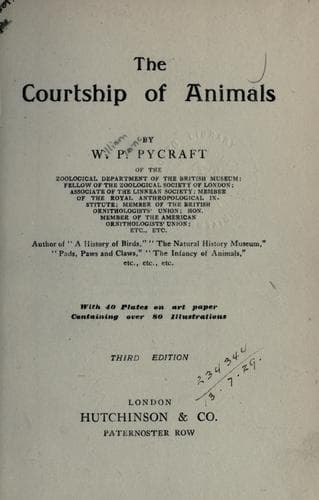
The Courtship of AnimalsPycraft, W. P. (William Plane)
Science
The Courtship of Animals
Pycraft, W. P. (William Plane)
Animal behavior; Natural selection
Naturally one asks, can the whole thing be explained by the theory of
Kinetogenesis promulgated years ago by Cope? That is to say, are these
curious down-growths the result of a response to a stimulus set up in
the lower jaw by constant lateral blows dealt by the tusks against
the side of the jaw during the lateral movements of the jaw when
feeding or ruminating? Such movements in an Ungulate would be frequent
and constant: hence perhaps the more striking result. On account of
the scissor-like action of the jaws in the Sabre-tooth such lateral
movements were far less extensive, and less powerful. But though this
explanation sounds plausible, it presents many difficulties. In the
first place it seems to commit one to the admission that the responses
of the Somatoplasm during the life of the individual are transmitted
to the germ-plasm: that, in short, the characters acquired by the
individual during its lifetime are transmitted to its offspring. And
there are insuperable difficulties in the way of such a theory. Yet,
it must be admitted, it is no less difficult to believe that this
correlation of growth is due solely to fortuitous variation, for one
cannot really conceive of a variation of this kind taking place in two
such different structures independently. Such a conception would have
been less difficult if the case of Dinoceros alone were known to us.
We could have supposed that, somehow, the lower jaw started to produce
its flange just as the teeth began to develop an excess of growth which
carried their points beyond the level of the jaw. But the Sabre-tooth
shows that the tusks had assumed a growth relatively exaggerated as
in Dinoceros, and yet the flange never attained to more than feeble
development. We cannot rest content with the theory that the flange is
due to the constant stimulus of blows struck against this region of the
jaw during the lateral movements which take place when feeding. Were
these animals alive to-day it could be tested by extracting the tusks
during infancy, when, the stimulus being removed, the flanges should
not appear.
There are yet other aspects of the skull of Dinoceros which may well
be considered here. The first concerns the excessive armature of
horns, there being no less than three pairs supported on massive bony
cores; and the second the ridiculously small brain cavity which is
proportionately smaller than that of any other known mammal, recent or
fossil. This poverty of brain-power was probably one, if not the chief,
factor among the causes which brought about the extinction of this
strange beast. Even more formidable horns were borne by the extinct
Arsinoetherium. But this animal did not display the double armature of
horns and tusks.
Public-domain text, read in full here on John Shaqi.
Reviews
Reviews
No reviews yet
Be the first to share your thoughts on this work.
Elsewhere in the archive
Join the Discussion
Join the discussion
Sign in to leave a comment or review.
Sign InorCreate an account