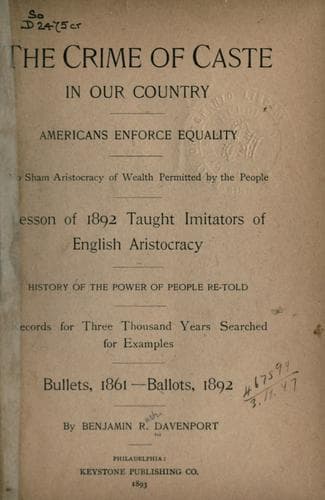
The Crime of Caste in Our CountryDavenport, Benjamin Rush
History
The Crime of Caste in Our Country
Davenport, Benjamin Rush
Social problems; United States -- Social conditions -- 1865-1918
In every little village and town, and even through the farming
sections, there is some would-be Ward McAllister and “smart set;”
some little circle who from some imagined cause or reason, in their
own conceit are a little better than the typical old settlers of our
country, who brought the Republic into existence. They try to impress,
and sometimes most insultingly, this supposed superiority upon the
minds of the “Common People.” In one little village it will be, for
example, the owner of some protected little factory, which, in the
wisdom of the legislators, has been protected to encourage and increase
the industries of our country. In the solicitude of the legislators for
the welfare of the people (acting honestly and in the best interests
of the country), they have created the possibility for this man, this
small manufacturer in the little village referred to, to accumulate
a few thousand dollars more than his fellow citizens of the little
village. The money has not been earned either by his sagacity, business
ability, superior education, nor his intrinsic merit as a commercial
genius. It is the result of accidents and the necessity that the
legislators honestly felt existed, to create manufactories in our own
country, to furnish the articles consumed by the people, rather than to
buy the same from England and other foreign countries, sending our gold
abroad out of the country in payment therefor.
The honesty of purpose and the wisdom of the action of the legislative
part of the Government, it is not the province of this book to
question. It is to record the result of the action upon the social
relations of the different members of that little community, or
village, in which the small factory was established, and the attendant
unhappiness arising from the accumulation of a disproportioned amount
of money in the hands of one of the citizens of the community. The
manufacturer, becoming prosperous, began to assume an air of social
superiority. He was enabled to take a trip every now and again to
some near-by city. He there saw his model McAllister. He returned to
his village with un-American affectations, aping the manner of his
model--the McAllister of his near-by city. He began to draw around
him (in much the same manner as McAllister describes the creation of
the “Patriarchs” of New York) those whom he deemed suitable for that
superior social position which he, modelling the machinery after the
manner of the city McAllister, deemed so desirable.
Public-domain text, read in full here on John Shaqi.
Reviews
Reviews
No reviews yet
Be the first to share your thoughts on this work.
Elsewhere in the archive
Join the Discussion
Join the discussion
Sign in to leave a comment or review.
Sign InorCreate an account