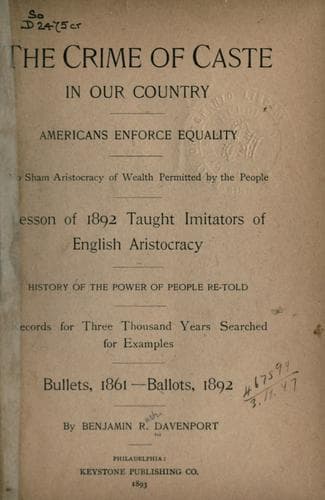
The Crime of Caste in Our CountryDavenport, Benjamin Rush
History
The Crime of Caste in Our Country
Davenport, Benjamin Rush
Social problems; United States -- Social conditions -- 1865-1918
The war, which had been the outgrowth of the election of the candidate
of the Republican party, created expenses which the Republican
administration had to meet, and as a means to that end it became
necessary to increase the existing duty and to place new duties upon
imported manufactured articles. And by so doing they carried to a
successful termination the great struggle for the preservation of
the Union, to which the Republican party had pledged itself; which,
together with the inclination and desire of some of the prominent
members of the Republican party to increase the manufacturing
industries of the country, has brought about that Protection and tariff
by which he, the village manufacturer, has profited. He never stops
to consider whether the tariff was a means to the end so profoundly
desired, the preservation of the Union, a means of furnishing sinews
of war by which the stars were retained upon our flag. He regards the
tariff and Protection only in its personal aspect. The Republican
party, to him, means his benefactor, to whom he owes an eternal debt of
gratitude for enabling him to acquire that which, without Protection
and tariff, he never could have obtained in the open field of the
commercial battle wherein the world at large may contend. The position
held by great thinkers of the Abraham Lincoln period is utterly
unappreciated by him. That this tariff and Protection, which has been
such a boon to him, was not created for his especial benefit, never
suggests itself to his mind; that men of the Lincoln day and stamp
should have had in view only the preservation of the Union and creating
a fund to pay the expenses of those engaged to accomplish that end,
does not occur to the village manufacturer.
In fact, many of the Republican politicians have made too much of
the Protection doctrine and not enough of the cause that created it.
This village, protected, small manufacturer, communing with himself,
concludes that without Protection he could never have amassed that
wealth which he is endeavoring to make elevate him above the social
status of his fellow citizens. He acknowledges, possibly, to himself,
that without Protection he might still be struggling for existence upon
an equal plane with the “Common People,” above whose heads he hopes
to elevate himself socially. He regards only the Republican party of
to-day, utterly oblivious to the fact that he and men of the McAllister
and the “smart set” type have no just appreciation and no great
admiration for the father of the Republican party, Abraham Lincoln, and
his doctrines, which are the doctrines and sentiments of the “Common
People.” He merely knows that Protection helped _him_, and he cares
nothing for what it was that brought about Protection and compelled the
Republican party to advocate a high tariff during the Civil War.
Public-domain text, read in full here on John Shaqi.
Reviews
Reviews
No reviews yet
Be the first to share your thoughts on this work.
Elsewhere in the archive
Join the Discussion
Join the discussion
Sign in to leave a comment or review.
Sign InorCreate an account