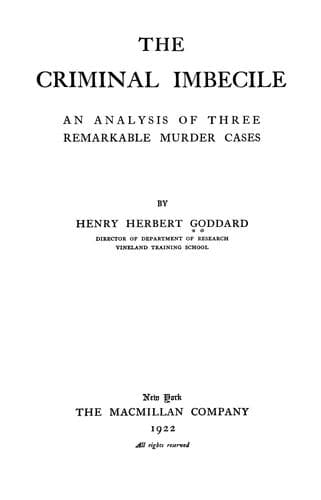
The Criminal Imbecile: An Analysis of Three Remarkable Murder CasesGoddard, Henry Herbert
Science
The Criminal Imbecile: An Analysis of Three Remarkable Murder Cases
Goddard, Henry Herbert
Crime -- Case studies; Murder -- Case studies; Offenders with mental disabilities -- Case studies
Pennington, as we have claimed, is an imbecile with a mentality of about
eleven years. We have a right to judge him largely on the basis of an
eleven-year-old child. The testimony of eleven-year-old children is often
admitted into court, and many a person has been convicted on such
testimony. It is true that it is a somewhat moot question as to how much
credence should be placed in children's testimony. The real criterion in
such cases is the nature of the child, a matter which we have already
considered. A child may testify to simple facts, and may be relied upon
where he has no particular interest, where there cannot be shown any
tendency or desire on the part of the child to show off or to say
something for effect or to exercise childish imagination and invent a
large story for the sake of the pleasing sound.
It is perfectly clear to any one who studies the confession of Pennington
that he must have told a straight-forward story. As already stated, he
would not have incriminated himself as he did if he had been falsifying.
He is not the type of person that runs on in an imaginary tale without
regard to the facts. In short, his testimony bears every evidence of being
entirely credible.
On the other hand, as already pointed out, Gianini's testimony is
unreliable, because he was talking for effect. He is of the type that
loves show and notoriety. His testimony was only to be trusted where it
could be corroborated by facts or the testimony of others.
Careful study of the testimony and the nature and the character of the
child will almost always enable one to decide very accurately as to how
much credence is to be placed in the evidence. In other words, the fact of
high-grade imbecility does not of itself make the child's testimony
acceptable or non-acceptable. It must be judged on its merits. We have in
these two cases excellent examples of the trustworthy and untrustworthy.
Public-domain text, read in full here on John Shaqi.
Reviews
Reviews
No reviews yet
Be the first to share your thoughts on this work.
Join the Discussion
Join the discussion
Sign in to leave a comment or review.
Sign InorCreate an account