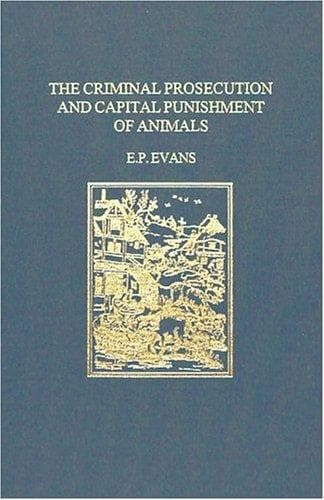
The Criminal Prosecution and Capital Punishment of AnimalsEvans, E. P. (Edward Payson)
History
The Criminal Prosecution and Capital Punishment of Animals
Evans, E. P. (Edward Payson)
Animals -- Law and legislation -- History; Animals, Prosecution and punishment of -- History; Trials -- Europe
Unfortunately this belief is not confined to Catholics and boors, but is
held by Protestants, who are considered persons of education and superior
culture. Dr. Lyman Abbott asserted in a sermon preached in Plymouth
Church, that “what we call the impulses of our lower nature are the
whispered suggestions of fiend-like natures, watching for our fall and
exultant if they can accomplish it.” But while affirming that “evil
spirits exercise an influence over mankind,” and that cranks like Guiteau,
the assassin of President Garfield, are diabolically possessed, the
reverend divine would hardly risk his reputation for sanity by attempting
to exorcise the supposed demon. The Catholic priest holds the same view,
but has the courage of his convictions and goes solemnly to work with
bell, book and candle to effect the expulsion of the indwelling fiend.
The fact that such methods of healing are sometimes successful is adduced
as conclusive proof of their miraculous character; but this inference is
wholly incorrect. Professor Dr. Hoppe, in an essay on _Der Teufels- und
Geisterglaube und die psychologische Erklärung des Besessenseins_
(_Allgemeine Zeitschrift für Psychiatrie_, Bd. LV. p. 290), gives a
psychological explanation of these puzzling phenomena. “The priest,” he
says, “exerts a salutary influence upon the brain through the respect and
dignity which he inspires, just as Christ in his day wrought upon those
who were sick and possessed with devils.” Indeed, it is expressly stated
by the evangelist that Jesus did not attempt to do wonderful works among
people who did not believe. According to this theory the exorcism effects
a cure by its powerful action on the imagination, just as there are
frequent ailments, for which a wise physician administers bread pills and
a weak solution of powdered sugar as the safest and best medicaments.
Professor Hoppe, therefore, approves of “priestly conjurations for the
expulsion of devils as a psychical means of healing,” and thinks that the
more ceremoniously the rite can be performed in the presence of grave and
venerable witnesses, the more effective it will be. This opinion is
endorsed by a Catholic priest, Friedrich Jaskowski, in a pamphlet entitled
_Der Trierer Rock und seine Patienten vom Jahre 1891_ (Saarbrücken: Carl
Schmidtke, 1894). The author belongs to the diocese of Trier and is
therefore under the jurisdiction of the bishop, Dr. Felix Korum, whose
statements concerning the miracles wrought and the evidences of divine
mercy manifested during the exhibition of the “holy coat” in 1891 he
courageously reviews and conclusively refutes. The bishop had printed what
he called “documentary proofs,” consisting of certificates issued by
obscure curates and country doctors, that certain persons suffering
chiefly from diseases of the nervous system had been healed, and sought to
discover in these cures the working of divine agencies. Jaskowski shows
Public-domain text, read in full here on John Shaqi.
Reviews
Reviews
No reviews yet
Be the first to share your thoughts on this work.
Join the Discussion
Join the discussion
Sign in to leave a comment or review.
Sign InorCreate an account