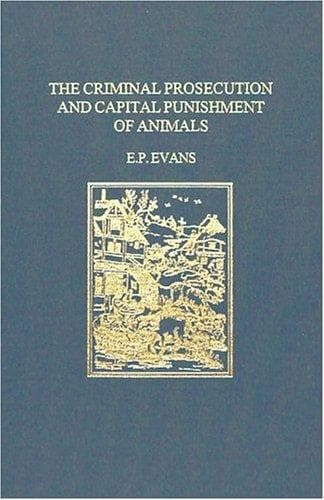
The Criminal Prosecution and Capital Punishment of AnimalsEvans, E. P. (Edward Payson)
History
The Criminal Prosecution and Capital Punishment of Animals
Evans, E. P. (Edward Payson)
Animals -- Law and legislation -- History; Animals, Prosecution and punishment of -- History; Trials -- Europe
degradation is the first act of God’s vengeance executed on his foes. It
is a foretaste of hell.”
Only by such an assumption, as our author proceeds to show, is it possible
to justify the ways of man to the lower animals and to reconcile his cruel
treatment of them with the goodness of an all-wise and all-powerful maker
and ruler of the universe. For this reason, he goes on to explain, the
Christian Church has never deemed it a duty to take the lower animals
under its protection or to inculcate ordinary natural kindness towards
them. Hence in countries, like Italy and Spain, where the influence of
Catholicism has been supreme for centuries, not only are wild birds and
beasts of chase relentlessly slaughtered and exterminated, but even useful
domestic animals, asses, sumpter-mules and pack-horses, are subjected to a
supererogation of suffering at the hands of ruthless man. As the pious
Parsi conscientiously comes up to the help of Ahuramazda against the
malevolent Angrô-mainyush by killing as many as possible of the creatures
which the latter has made, so the good Catholic becomes an efficient
co-worker with God by maltreating brutes and thus aiding the Almighty in
punishing the devils, of which they are the visible and bruisable forms.
Whatever pain is inflicted is felt, not by the physical organism, but by
the animated spirit. It is the embodied demon that really suffers, howling
in the beaten dog and squealing in the butchered pig.
There are doubtless many persons of tender susceptibilities, who cannot
bear to think that the animals, whose daily companionship we enjoy, the
parrot we feed with sugar, the pretty pug we caress and the noble horse,
which ministers to our comfort and convenience, are nothing but devils
predestined to everlasting torture. But these purely sentimental
considerations are of no weight in the scale of reason. “What matters it,”
replies the Jesuit Father, “whether it is a devil or another kind of
creature that is in our service or contributes to our amusement? For my
part, this idea pleases rather than repels me; and I recognize with
gratitude the beneficence of the Creator in having provided me with so
many little devils for my use and entertainment. If it be said that these
poor creatures, which we have learned to love and so fondly cherish, are
fore-ordained to eternal torments, I can only adore the decrees of God,
but do not hold myself responsible for the terrible sentence; I leave the
execution of the dread decision to the sovereign judge and continue to
live with my little devils, as I live pleasantly with a multitude of
persons, of whom, according to the teachings of our holy religion, the
great majority will be damned.” The crafty disciple of Loyola, elusive of
disagreeable deductions, is content to accept the poodle in its phenomenal
form and to make the most of it, without troubling himself about “des
Pudels Kern.”
Public-domain text, read in full here on John Shaqi.
Reviews
Reviews
No reviews yet
Be the first to share your thoughts on this work.
Elsewhere in the archive
Join the Discussion
Join the discussion
Sign in to leave a comment or review.
Sign InorCreate an account