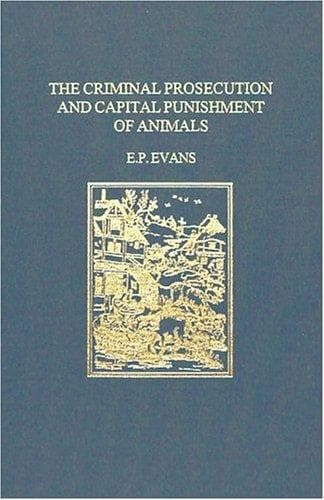
The Criminal Prosecution and Capital Punishment of AnimalsEvans, E. P. (Edward Payson)
History
The Criminal Prosecution and Capital Punishment of Animals
Evans, E. P. (Edward Payson)
Animals -- Law and legislation -- History; Animals, Prosecution and punishment of -- History; Trials -- Europe
Father Bougeant calls his lucubration “a new system of philosophy”; but
this is not strictly true. He has only given a fuller and more facetious
exposition of a doctrine taught by many of the greatest lights of the
Catholic Church, among others by Thomas Aquinas, whose authority as a
thinker Pope Leo XIII. distinctly recognized and earnestly sought to
restore to its former prestige. Bougeant’s ingenious dissertation has a
vein of irony or at least a strain of jocundity in it, approaching at
times so perilously near the fatal brink of persiflage, that one cannot
help surmising an intention to render the whole thing ridiculous in a
witty and underhand way eminently compatible with Jesuitical habits of
mind; but whether serious or satirical, his treatise is an excellent
example and illustration of the kind of dialectic hair-splitting and
syllogistic rubbish, which passed for reasoning in the early and middle
ages of the Christian era, and which the greatest scholars and acutest
intellects of those days fondly indulged in and seem to have been fully
satisfied with. Here, too, we come upon the metaphysical and theological
groundwork, upon which was reared by a strictly logical process a vast
superstructure of ecclesiastical excommunication and criminal prosecution
against bugs and beasts. He protests with never-tiring and needless
iteration his absolute devotion to the precepts of religion; indeed, like
the lady in the play, he “protests too much, methinks.” In all humbleness
and submission he bows to the authority of the Church, and would not touch
the ark of the covenant even with the tip of his finger, but his easy
acquiescence has an air of perfunctoriness, and in his assenting lips
there lurks a secret, semi-sarcastic leer, which casts suspicion on his
words and looks like poking fun at the principles he professes and turning
them into raillery.
Indeed, such covert derision would have been a suitable way of ridiculing
the gross popular superstition of his time, which saw a diabolical
incarnation in every unfamiliar form of animal life. During the latter
half of the sixteenth century a Swiss naturalist named Thurneysser, who
held the position of physician in ordinary to the Elector Johann Georg von
Brandenburg, kept some scorpions bottled in olive oil, which were feared
by the common people as terrible devils endowed with magic power
(_fürchterliche Zauberteufel_). Thurneysser presented also to Basel, his
native city, a large elk, which had been given to him by Prince Radziwil;
but the good Baselers looked upon the strange animal as a most dangerous
demon, and a pious old woman finally rid the town of the dreaded beast by
feeding it with an apple stuck full of broken needles.
Public-domain text, read in full here on John Shaqi.
Reviews
Reviews
No reviews yet
Be the first to share your thoughts on this work.
Elsewhere in the archive
Join the Discussion
Join the discussion
Sign in to leave a comment or review.
Sign InorCreate an account