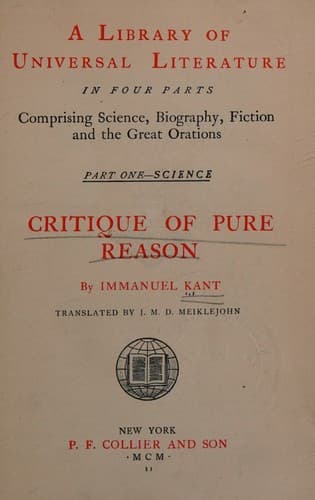
Causation; Knowledge, Theory of; Philosophy, German; Reason
The same is the case with the internal intuition, not only because, in
the internal intuition, the representation of the external senses
constitutes the material with which the mind is occupied; but because
time, in which we place, and which itself antecedes the consciousness
of, these representations in experience, and which, as the formal
condition of the mode according to which objects are placed in the
mind, lies at the foundation of them, contains relations of the
successive, the coexistent, and of that which always must be coexistent
with succession, the permanent. Now that which, as representation, can
antecede every exercise of thought (of an object), is intuition; and
when it contains nothing but relations, it is the form of the
intuition, which, as it presents us with no representation, except in
so far as something is placed in the mind, can be nothing else than the
mode in which the mind is affected by its own activity, to wit—its
presenting to itself representations, consequently the mode in which
the mind is affected by itself; that is, it can be nothing but an
internal sense in respect to its form. Everything that is represented
through the medium of sense is so far phenomenal; consequently, we must
either refuse altogether to admit an internal sense, or the subject,
which is the object of that sense, could only be represented by it as
phenomenon, and not as it would judge of itself, if its intuition were
pure spontaneous activity, that is, were intellectual. The difficulty
here lies wholly in the question: How can the subject have an internal
intuition of itself? But this difficulty is common to every theory. The
consciousness of self (apperception) is the simple representation of
the “ego”; and if by means of that representation alone, all the
manifold representations in the subject were spontaneously given, then
our internal intuition would be intellectual. This consciousness in man
requires an internal perception of the manifold representations which
are previously given in the subject; and the manner in which these
representations are given in the mind without spontaneity, must, on
account of this difference (the want of spontaneity), be called
sensibility. If the faculty of self-consciousness is to apprehend what
lies in the mind, it must all act that and can in this way alone
produce an intuition of self. But the form of this intuition, which
lies in the original constitution of the mind, determines, in the
representation of time, the manner in which the manifold
representations are to combine themselves in the mind; since the
subject intuites itself, not as it would represent itself immediately
and spontaneously, but according to the manner in which the mind is
internally affected, consequently, as it appears, and not as it is.
Public-domain text, read in full here on John Shaqi.
Reviews
Reviews
No reviews yet
Be the first to share your thoughts on this work.
Elsewhere in the archive
Join the Discussion
Join the discussion
Sign in to leave a comment or review.
Sign InorCreate an account