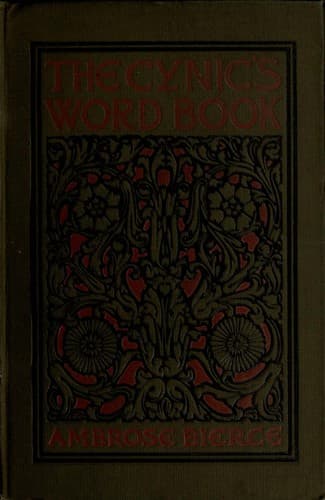
English language -- Dictionaries -- Humor; English language -- Semantics -- Humor; Vocabulary -- Humor
IMPALE, v. t. In popular usage to pierce with any weapon which remains
fixed in the wound. This, however, is inaccurate; to impale is,
properly, to put to death by thrusting an upright sharp stake into the
body, the victim being left in a sitting position. This was a common
mode of punishment among many of the nations of antiquity, and is still
in high favor in China and other parts of Asia. Down to the beginning of
the Fifteenth Century it was widely employed in churching heretics and
schismatics. Wolecraft calls it the "stoole of repentynge," and among
the common people it was jocularly known as "riding the one legged
horse." Ludwig Salzmann informs us that in Thibet impalement is
considered the most appropriate punishment for crimes against religion;
and although in China it is sometimes awarded to secular offences, it is
most frequently adjudged in cases of sacrilege. To the person in actual
experience of impalement it must be a matter of minor importance by
what kind of civil or religious dissent he was made acquainted with its
discomforts; but doubtless he would feel a certain satisfaction if able
to contemplate himself in the character of a weather-cock on the spire
of the True Church.
IMPARTIAL, adj. Unable to perceive any promise of personal advantage
from espousing either side of a controversy or adopting either of two
conflicting opinions.
IMPENITENCE, n. A state of mind intermediate in point of time between
sin and punishment.
IMPIETY, n. Your irreverence toward my deity.
IMPOSITION, n. The act of blessing or consecrating by the laying on of
hands--a ceremony common to many ecclesiastical systems, but performed
with the frankest sincerity by the sect known as Thieves.
"Lo! by the laying on of hands,"
Say parson, priest, and dervise,
"We consecrate your cash and lands
To ecclesiastic service.
No doubt you 'll swear till all is blue
At such an imposition. Do."
Polio Doncas,
IMPOSTOR, n. A rival aspirant to public honors.
IMPROBABILITY, n.
His tale he told with a solemn face
And a tender, melancholy grace.
Improbable't was, no doubt,
When you came to think it out,
But the fascinated crowd
Their deep surprise avowed
And all with a single voice averred
'T was the most amazing thing they 'd heard--
All save one who spake never a word,
But sat as mum
As if deaf and dumb,
Serene, indifferent, and unstirred.
Then all the others turned to him
And scrutinized him limb from limb--
Scanned him alive,
But he seemed to thrive
And tranquiler grow each minute,
As if there were nothing in it.
"What! what!" cried one, "are you not amazed
At what our friend has told?" He raised
Soberly then his eyes and gazed
In a natural way
And proceeded to say,
As he crossed his feet on the mantel-shelf:
"O no--not at all; I'ma liar myself."
Public-domain text, read in full here on John Shaqi.
Reviews
Reviews
No reviews yet
Be the first to share your thoughts on this work.
Join the Discussion
Join the discussion
Sign in to leave a comment or review.
Sign InorCreate an account