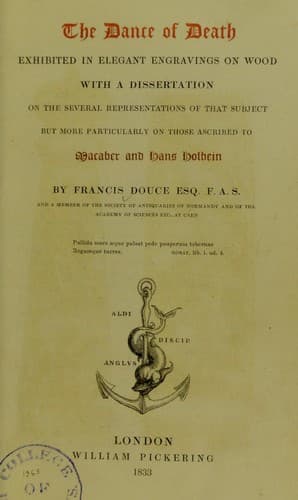
The Dance of Death: Exhibited in Elegant Engravings on Wood with a Dissertation on the Several Representations of that Subject but More Particularly on Those Ascribed to Macaber and Hans HolbeinDouce, Francis
History
The Dance of Death: Exhibited in Elegant Engravings on Wood with a Dissertation on the Several Representations of that Subject but More Particularly on Those Ascribed to Macaber and Hans Holbein
Douce, Francis
Bible. Old Testament -- Illustrations; Dance of death
No. XII. "Heures à l'usaige de Rome. Guil. Godar," 1510, large 8vo. vellum
illuminated. A magnificent book. It contains the Danse Macabre as in No.
I. But it is remarkable for a third Dance of Death on the margins at
bottom, consisting of small compartments with a single figure, but
unaccompanied in the usual manner by Death, who, in various shapes and
attitudes, is occasionally introduced. The characters are the following,
without the arrangement commonly observed, and here given in the order in
which they occur. 1. La Prieuse. 2. La Garde dacouche. 3. L'Abesse. 4. Le
Promoteur. 5. Le Conestable. 6. Le Moine, without a label. 7. La Vielle
Demoiselle. 8. La Baillive. 9. La Duchesse. 10. Le Sergent. 11. La
Nourrice. 12. La femme du Chevallier. 13. La Damoiselle. 14. Le Maistre
descole. 15. La Femme du village. 16. La Rescomanderese. 17. La
Revenderese. 18. Le Laboureur. 19. La Bourgoise. 20. L'Usurier. 21. Le
Pelerin. 22. Le Berger. 23. La Religieuse. 24. L'Home d'armes. 25. La
Sorciere. 26. Le Petit enfant. 27. Le Clerc. 28. Le Patriarche. 29. Le
Cardinal. 30. L'Empereur. 31. Le Roy. 32. La Marchande. 33. Le Curé. 34.
La Theologienne. 35. La Jeune fille. 36. Le Sot. 37. Le Hallebardier. 38.
La Pucelle vierge. 39. L'Hermite. 40. L'Escuier. 41. La Chamberiere. 42.
La Femme de lescuier. 43. La Cordeliere. 44. La Femme veuve. 45. Le
Chartreux. 46. La Royne. 47. La Regente. 48. La Bergere. 49. L'Advocat.
50. L'Espousée. 51. La Femme amoureuse. 52. La Nouvelle Mariee. 53. Le
Medecin. Wherever the figure of Death is introduced, he is accompanied
with the motto "Amort, amort."
No. XIII. "Hore ad usum Romanum. Thielman Kerver," 1511, 8vo. Vellum, with
the Danse Macabre.
No. XIV. "Heures à l'usage de Langres. Simon Vostre," 1512, 8vo. In the
possession of Mons. G. M. Raymond, who has described it in Millin's
"Magazin Encyclopédique," 1814, tom. iii. p. 13. Mentioned also by M.
Peignot.
No. XV. "Heures à l'usage de Paris. Simon Vostre," 1515, 8vo. With the
Danse Macabre, and the other mentioned in No. I.
No. XVI. "Heures de Nostre Dame à l'usage de Troyes." Th. Englard, pour G.
Goderet, vers 1520. Vellum. Described by M. Peignot.
No. XVII. "Hore ad usum Romanum. Thielman Kerver," 1526, 8vo. Vellum. A
beautiful volume. Prefixed to the Danse Macabre are two prints of the
Trois morts et trois vifs.
In all the above Horæ the Macaber Dance is represented nearly alike in
design, the variations being chiefly in the attitudes of the figures,
which are cut on different blocks, except in a few instances where the
printers have borrowed the latter from each other. Thus Vostre uses
Verard's, and Pigouchet Godar's. The number of the subjects also varies,
Vostre and Kerver having more than Verard, Godar, and Pigouchet.
Exceptions to the above manner of representing the Macaber Dance, occur in
two Horæ of singular rarity, and which are therefore worthy of particular
notice.
Public-domain text, read in full here on John Shaqi.
Reviews
Reviews
No reviews yet
Be the first to share your thoughts on this work.
Join the Discussion
Join the discussion
Sign in to leave a comment or review.
Sign InorCreate an account