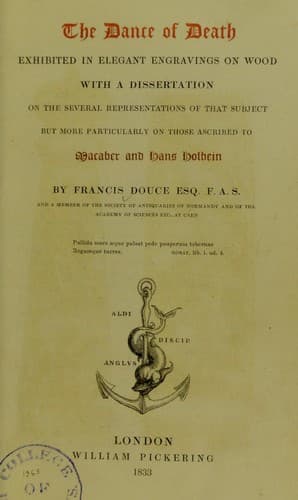
The Dance of Death: Exhibited in Elegant Engravings on Wood with a Dissertation on the Several Representations of that Subject but More Particularly on Those Ascribed to Macaber and Hans HolbeinDouce, Francis
History
The Dance of Death: Exhibited in Elegant Engravings on Wood with a Dissertation on the Several Representations of that Subject but More Particularly on Those Ascribed to Macaber and Hans Holbein
Douce, Francis
Bible. Old Testament -- Illustrations; Dance of death
No. XVIII. "Officium beatæ Mariæ Virginis ad usum Romane ecclesie.
Impressum Lugduni expensis Bonini de Boninis Dalmatini," die xx martij,
1499, 12mo. On vellum. Here the designs are very different, and three of
the subjects are placed at the bottom of the page. They consist of the
following personages, there being no females among them. It was reprinted
by the same printer in 1521.
Papa Astrologus
Imperator Cives
Cardinales. Canonicus.
Archiepiscopus Scutifer
Eques Abbas
Episcopus. Pretor.
Rex Monachus
Patriarche Usurarius
Capitanus. Medicus.
Plebanus Mercator
Laborator Certosinus
Frater Minor. Nuncius.
Amans Puer
Advocatus Sacristanus
Joculator. Heremita.
No. XIX. "Hore beate Marie Virginis ad usum insignis ac preclare ecclesie
Sarum cum figuris passionis mysterium representantibus recenter additis.
Impresse Parisiis per Johannem Bignon pro honesto viro Richardo Fakes,
London, librario, et ibidem commorante cymeterie Sancti Pauli sub signo A.
B. C." 1521. A ledger-like 12mo. This Macaber Dance is unfortunately
imperfect in the only copy of the book that has occurred. The figures that
remain are those of the Pope, King, Cardinal, Patriarch, Judge,
Archbishop, Knight, Mayor, and Earl.
Under each subject are Lydgate's verses, with some slight variation; and
it is therefore very probable that we have here a copy, as to many of the
figures, of the Dance that was painted at St. Paul's in compartments like
the other Macaber Dance, and not as the group in Dugdale, which has been
copied from a wood-cut at the end of Lydgate's "Fall of Prynces." As all
the before-mentioned Horæ were printed at Paris, with one exception only,
and many of them at a very early period, it is equally probable that they
may be copies of the Dance at the Innocents, unless a preference in that
respect should be given to the figures in the French editions of the Danse
Macabre.
Manuscript Horæ, or books of prayers, which contain the Macaber Dance are
in the next place deserving of our attention. These are extremely rare,
and two only have occurred on the present occasion.
1. A manuscript prayer book of the fifteenth century is very briefly
described by M. Peignot,[88] which he states to be the only one that has
come to his knowledge.
2. An exquisitely beautiful volume, in large 8vo. bound in brass and
velvet. It is a Latin Horæ, elegantly written in Roman type at the
beginning of the 16th century. It has a profusion of paintings, every page
being decorated with a variety of subjects. These consist of stories from
scripture, sports, games, trades, grotesques, &c. &c. the several
employments of the months, which have also the signs of the zodiac, are
worth describing, there being two sets for each month.
Public-domain text, read in full here on John Shaqi.
Reviews
Reviews
No reviews yet
Be the first to share your thoughts on this work.
Join the Discussion
Join the discussion
Sign in to leave a comment or review.
Sign InorCreate an account