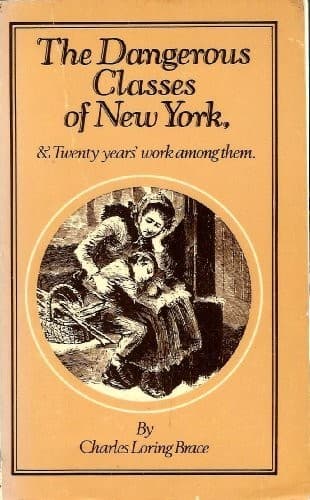
The Dangerous Classes of New York, and Twenty Years' Work Among ThemBrace, Charles Loring
History
The Dangerous Classes of New York, and Twenty Years' Work Among Them
Brace, Charles Loring
Child welfare -- New York (State) -- New York; New York (N.Y.) -- Social conditions; Poor -- New York (State) -- New York
E. Williams, also a Unitarian. Mr. W. had also been engaged
in similar charities in Boston.
During the first year, we added to our board from the Methodists, Dr. J.
L. Phelps; from the Episcopalians, Mr. Archibald Russell (since
deceased), who has accomplished so much as the President of the Board of
the Five Points House of Industry; Mr. George Bird, and Mr. A. S.
Hewitt, who is now the managing head of that great educational
institution, the Cooper Union; from the Presbyterians, the celebrated
Mr. Cyrus W. Field; and from the "Come Outers," Mr. C. W. Elliott, the
genial author of the "New England History." Of all the first trustees,
the only ones in office in 1871 are J. E. Williams, B. J. Howland, M. T.
Hewitt, and C. L. Brace.
On a subsequent year we elected a gentleman who especially represented a
religious body that has always profoundly sympathized with our
enterprise--Mr. Howard Potter, the son of the eminent Episcopal Bishop
of Pennsylvania, and nephew of the Bishop of New York. And yet, of all
the members of our Board, no one has been more entirely unsectarian than
this trustee; and certainly no one has thrown into our charity more
heart and a more unbiased judgment. Mr. Potter is still trustee. Through
him and Mr. B. J. Livingston, who was chosen a few years after, the
whole accounts of the Society were subsequently put in a clear shape,
and the duties of the trustees in supervision made distinct and
regular.
It is an evidence of the simple desire for doing good which actuated
these gentlemen, and of the possibility of a "Christian Union" that,
though representing so many different sects, and ardently attached to
them, there never was in all the subsequent years the slightest
difference among them resulting from their divergent views on
speculative topics. Nearly all of them were engaged practically in
laboring among the dangerous classes. Mr. Howland and Mr. Russell had
struggled most earnestly for a considerable period to reform the morals
and elevate the character of the degraded population near "Rotten Row,"
in Laurens street, and their "Boys' Meeting" had been one of the most
spirited efforts in this direction to be seen in the city.
Several of the gentlemen I have mentioned have become distinguished in
their various professions, but it maybe doubted if they will look back
on any action of their public careers with more satisfaction than their
first earnest efforts to lay firmly the foundations of a broad structure
of charity, education, and reform.
The organization was happily named
"THE CHILDREN'S AID SOCIETY OF NEW YORK."
This association, which, from such small beginnings has grown to so
important dimensions, was thus formed in 1853, and was subsequently
incorporated in 1856, under the general Act of the State of New York in
relation to Charitable Associations.
A small office on the corner of Amity Street was opened, with a single
lad in attendance, besides the present writer.
Public-domain text, read in full here on John Shaqi.
Reviews
Reviews
No reviews yet
Be the first to share your thoughts on this work.
Elsewhere in the archive
Join the Discussion
Join the discussion
Sign in to leave a comment or review.
Sign InorCreate an account