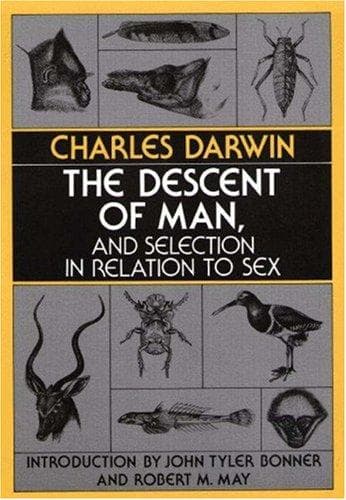
The Descent of Man, and Selection in Relation to SexDarwin, Charles
History
The Descent of Man, and Selection in Relation to Sex
Darwin, Charles
Evolution (Biology); Human beings -- Origin; Sex differences; Sexual dimorphism (Animals); Sexual selection in animals
Turning now to the nearest allies of men, and therefore to the best
representatives of our early progenitors, we find that the hands of the
Quadrumana are constructed on the same general pattern as our own, but
are far less perfectly adapted for diversified uses. Their hands do not
serve for locomotion so well as the feet of a dog; as may be seen in
such monkeys as the chimpanzee and orang, which walk on the outer
margins of the palms, or on the knuckles. (69. Owen, ‘Anatomy of
Vertebrates,’ vol. iii. p. 71.) Their hands, however, are admirably
adapted for climbing trees. Monkeys seize thin branches or ropes, with
the thumb on one side and the fingers and palm on the other, in the
same manner as we do. They can thus also lift rather large objects,
such as the neck of a bottle, to their mouths. Baboons turn over
stones, and scratch up roots with their hands. They seize nuts,
insects, or other small objects with the thumb in opposition to the
fingers, and no doubt they thus extract eggs and young from the nests
of birds. American monkeys beat the wild oranges on the branches until
the rind is cracked, and then tear it off with the fingers of the two
hands. In a wild state they break open hard fruits with stones. Other
monkeys open mussel-shells with the two thumbs. With their fingers they
pull out thorns and burs, and hunt for each other’s parasites. They
roll down stones, or throw them at their enemies: nevertheless, they
are clumsy in these various actions, and, as I have myself seen, are
quite unable to throw a stone with precision.
It seems to me far from true that because “objects are grasped
clumsily” by monkeys, “a much less specialised organ of prehension”
would have served them (70. ‘Quarterly Review,’ April 1869, p. 392.)
equally well with their present hands. On the contrary, I see no reason
to doubt that more perfectly constructed hands would have been an
advantage to them, provided that they were not thus rendered less
fitted for climbing trees. We may suspect that a hand as perfect as
that of man would have been disadvantageous for climbing; for the most
arboreal monkeys in the world, namely, Ateles in America, Colobus in
Africa, and Hylobates in Asia, are either thumbless, or their toes
partially cohere, so that their limbs are converted into mere grasping
hooks. (71. In Hylobates syndactylus, as the name expresses, two of the
toes regularly cohere; and this, as Mr. Blyth informs me, is
occasionally the case with the toes of H. agilis, lar, and leuciscus.
Colobus is strictly arboreal and extraordinarily active (Brehm,
‘Thierleben,’ B. i. s. 50), but whether a better climber than the
species of the allied genera, I do not know. It deserves notice that
the feet of the sloths, the most arboreal animals in the world, are
wonderfully hook-like.
Public-domain text, read in full here on John Shaqi.
Reviews
Reviews
No reviews yet
Be the first to share your thoughts on this work.
Join the Discussion
Join the discussion
Sign in to leave a comment or review.
Sign InorCreate an account