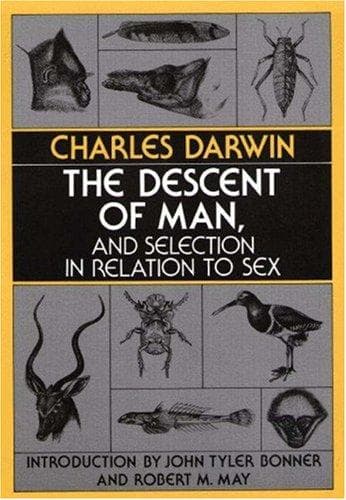
The Descent of Man, and Selection in Relation to SexDarwin, Charles
History
The Descent of Man, and Selection in Relation to Sex
Darwin, Charles
Evolution (Biology); Human beings -- Origin; Sex differences; Sexual dimorphism (Animals); Sexual selection in animals
As the progenitors of man became more and more erect, with their hands
and arms more and more modified for prehension and other purposes, with
their feet and legs at the same time transformed for firm support and
progression, endless other changes of structure would have become
necessary. The pelvis would have to be broadened, the spine peculiarly
curved, and the head fixed in an altered position, all which changes
have been attained by man. Prof. Schaaffhausen (76. ‘On the Primitive
Form of the Skull,’ translated in ‘Anthropological Review,’ Oct. 1868,
p. 428. Owen (‘Anatomy of Vertebrates,’ vol. ii. 1866, p. 551) on the
mastoid processes in the higher apes.) maintains that “the powerful
mastoid processes of the human skull are the result of his erect
position;” and these processes are absent in the orang, chimpanzee,
etc., and are smaller in the gorilla than in man. Various other
structures, which appear connected with man’s erect position, might
here have been added. It is very difficult to decide how far these
correlated modifications are the result of natural selection, and how
far of the inherited effects of the increased use of certain parts, or
of the action of one part on another. No doubt these means of change
often co-operate: thus when certain muscles, and the crests of bone to
which they are attached, become enlarged by habitual use, this shews
that certain actions are habitually performed and must be serviceable.
Hence the individuals which performed them best, would tend to survive
in greater numbers.
The free use of the arms and hands, partly the cause and partly the
result of man’s erect position, appears to have led in an indirect
manner to other modifications of structure. The early male forefathers
of man were, as previously stated, probably furnished with great canine
teeth; but as they gradually acquired the habit of using stones, clubs,
or other weapons, for fighting with their enemies or rivals, they would
use their jaws and teeth less and less. In this case, the jaws,
together with the teeth, would become reduced in size, as we may feel
almost sure from innumerable analogous cases. In a future chapter we
shall meet with a closely parallel case, in the reduction or complete
disappearance of the canine teeth in male ruminants, apparently in
relation with the development of their horns; and in horses, in
relation to their habit of fighting with their incisor teeth and hoofs.
Public-domain text, read in full here on John Shaqi.
Reviews
Reviews
No reviews yet
Be the first to share your thoughts on this work.
Elsewhere in the archive
Join the Discussion
Join the discussion
Sign in to leave a comment or review.
Sign InorCreate an account