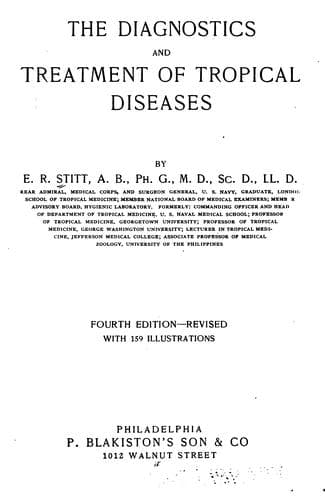
The diagnostics and treatment of tropical diseasesStitt, E. R. (Edward Rhodes)
Science
The diagnostics and treatment of tropical diseases
Stitt, E. R. (Edward Rhodes)
Tropical medicine
Almost any type of central nervous system disease may be simulated
as the result of focal sporulation so that we have aphasic,
epileptiform, hemiplegic, bulbar and other clinical types.
Some authors have recorded cases of multiple neuritis of malarial
origin. Catto has recently examined the blood of a number of cases
of multiple neuritis in Jamaica and has obtained negative malarial
findings in every case. Neuralgic manifestations are features of
latent malaria. Some loss of memory may be apparent after severe
malaria.
_The Special Senses._—Plugging of the retinal arteries may lead to
blindness which may be either transient or lasting. The discs are
grayish red instead of white as is the case with quinine amblyopia.
The ringing in the ears is connected with the quinine treatment.
_The Genito-urinary System._—In the cold stage there is apt to be
frequent urination with increased secretion. Later on, there is a
scanty febrile urine.
Albuminuria is rather common in aestivo-autumnal attacks and true
nephritis occurs in about 2% of cases.
Plehn attaches great importance to the examination of the urine for
urobilin as showing malarial infection when parasites cannot be
found. The pigment particles in urinary sediment (Uriola) do not
give reliable information. Bile in the urine is an important sign
of bilious remittent fever.
Orchitis has been reported as a malarial complication.
_The Liver and Spleen._—There is very little of importance to note
in connection with the liver except tenderness and jaundice in
bilious remittent fever. The spleen, however, is the organ in which
centers the infection and its tenderness and enlargement are of
special diagnostic value in malaria.
Even in comatose conditions pressure on the spleen may bring about
indications of pain. The liability to rupture of the friable spleen
of aestivo-autumnal infections is a real danger and the patient
should not expose himself to injury.
_The Blood Examination._—This is of prime value in the recognition
of malaria, and one should examine both fresh blood preparations
and stained films as well. More information is gotten from the
stained films but we should also avail ourselves of the different
characteristics of the 3 malarial species, which can be noted in a
preparation made by taking up a small drop of exuding blood on a
cover-glass and allowing it to drop on a slide and run out without
any pressure on the cover-glass.
The crescents, when found, show a malignant tertian infection but
there may also be present one of the benign parasites. A stained
film should be used to identify malignant tertian young ring forms.
Public-domain text, read in full here on John Shaqi.
Reviews
Reviews
No reviews yet
Be the first to share your thoughts on this work.
Join the Discussion
Join the discussion
Sign in to leave a comment or review.
Sign InorCreate an account