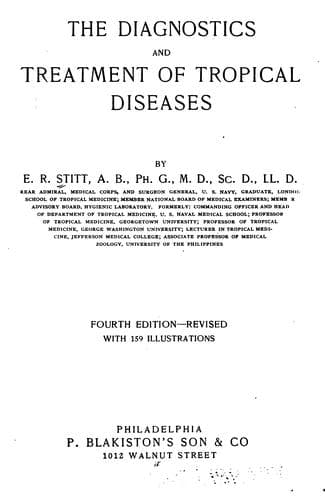
The diagnostics and treatment of tropical diseasesStitt, E. R. (Edward Rhodes)
Science
The diagnostics and treatment of tropical diseases
Stitt, E. R. (Edward Rhodes)
Tropical medicine
The ease of application of quinine prophylaxis, as compared with the
more permanent methods of mosquito destruction and screening, appeals
to the sanitarian, especially in the tropics.
It is just as easy to give quinine to a man in the tropics as it is
in temperate climates, but when one considers the propositions of
draining tropical swamps and shutting off circulation of air on a
torrid night with fine wire gauze in the windows and closely woven
mosquito nets around the bed, the question is decidedly different.
In consequence, the tendency is for the average man to despair
of accomplishing anything in the way of mosquito destruction and
screening and to seize eagerly on the inferior alternative, that of
quinine prophylaxis.
Ronald Ross presents this matter concisely and to the point when
he states that it is not a good policy to substitute a measure
which does not exclude infection, but is merely extirpative in
some cases, for positive prevention. From this it will be seen
that unless it is clearly recognized that quinine prophylaxis may
in some cases extirpate, but does not prevent, there might be a
tendency to adopt this measure and neglect the two proper ones.
As regards the relative merits of quinine prophylaxis and
protection from mosquitoes Celli gives the following figures:
Treatment Infected
Mosquito protection plus quinine prophylaxis 1.76 %
Mosquito protection alone 2.5 %
Quinine prophylaxis alone 20.0 %
No protection at all 33.0 %
With quinine prophylaxis, there is the possibility of producing
an immunity to quinine on the part of the parasites which have
been introduced by infected mosquitoes and held in check by the
prophylactic but not curative dose of quinine. Later on when the
quinine prophylaxis is discontinued the parasites begin to multiply
vigorously and seem to possess an immunity to quinine.
As an instance of this, 398 marines served in 1906 for about one
month on the Isthmus of Panama during which time they were given 9
grains of quinine daily as a prophylactic.
During this month there was only an occasional case of malaria
among the men. At the end of the month 298 of the original 398
returned aboard ship and sailed for the North. Two days later
20 cases of malaria developed, followed the next day by 53 and
the day following that by 45. The medical officer then resumed
10-grain prophylactic doses for those not down with malaria but
notwithstanding this there were 215 acute malarial paroxysms, some
of them of pernicious type, among the 298 men.
It was noted that these men did not respond satisfactorily
to quinine treatment even when the drug was administered
intramuscularly.
Public-domain text, read in full here on John Shaqi.
Reviews
Reviews
No reviews yet
Be the first to share your thoughts on this work.
Elsewhere in the archive
Join the Discussion
Join the discussion
Sign in to leave a comment or review.
Sign InorCreate an account