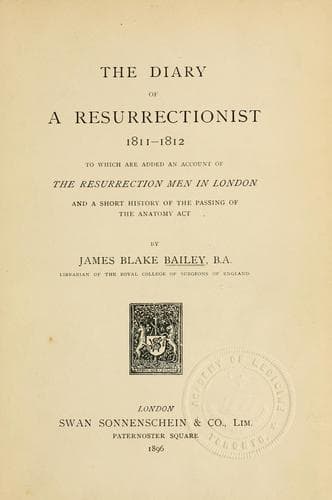
The Diary of a Resurrectionist, 1811-1812: To Which Are Added an Account of the Resurrection Men in London and a Short History of the Passing of the Anatomy ActBailey, James Blake
History
The Diary of a Resurrectionist, 1811-1812: To Which Are Added an Account of the Resurrection Men in London and a Short History of the Passing of the Anatomy Act
Bailey, James Blake
Body snatching
The statements in this broadside are quite true, and agree with the
account which is to be found in the _Liverpool Mercury_ for October 13th,
1826. Henderson, who was a Greenock man, and the principal in this
business, escaped, and could not be brought to justice; but a man named
James Donaldson, who was a party to the transaction, was made to pay a
fine of £50, and was sent to Kirkdale Gaol for twelve months.
From Ireland very many bodies were exported, chiefly to Edinburgh; a
better price could be obtained there than in Dublin, and the consequence
was that the Irish schools were often very badly supplied with subjects.
In Dublin there were several ancient burial-grounds, all badly protected;
the poor were all buried in one part, and, as their friends were generally
unable to afford watchers, their bodies fell an easy prey to the
resurrection-men. In January, 1828, the detection of a body about to be
exported caused a tumult in the streets of Dublin, and led to the murder
of a man named Luke Redmond, a porter at the College of Surgeons.[18] The
body-snatchers in Dublin seem to have done more damage than the men
engaged in a like occupation in London; they were not content with taking
the bodies, but, in addition, they broke the tomb-stones, and played
general havoc in the grave-yards.
According to the following cutting from the _Universal Spectator and
Weekly Journal_, May 20th, 1732 (printed in _Notes and Queries_, 5th ser.
i. 65), bodies were sometimes taken for other than dissection purposes.
"John Loftas, the Grave Digger, committed to prison for robbing of dead
corpse, has confess'd to the plunder of above fifty, not only of their
coffins and burial cloaths, but of their fat, where bodies afforded any,
which he retail'd at a high price to certain people, who, it is believed,
will be call'd upon on account thereof. Since this discovery several
persons have had their friends dug up, who were found quite naked, and
some mangled in so horrible a manner as could scarcely be suppos'd to be
done by a human creature."
Southey also refers to this in the poem before quoted, where he makes the
surgeon say in his lamentation,
"I have made candles of infants' fat."
CHAPTER III.
It is well-nigh impossible to read of all these misdoings and not to ask
why the Government did not step in and put a stop to them? It was urged by
many that a short Act should be passed, making the violation of a grave a
penal offence, as it was in France. There was a general agreement that
anatomical education was absolutely necessary for medical men, and that
this education was an impossibility without a supply of subjects; yet
there was a great reluctance to interfere by legislation. The Home
Secretary told a deputation that there was no difficulty in drawing up an
effective Bill; the great obstacle was the prejudice of the people against
any Bill; this impediment, he added, had not been trifling.
Public-domain text, read in full here on John Shaqi.
Reviews
Reviews
No reviews yet
Be the first to share your thoughts on this work.
Join the Discussion
Join the discussion
Sign in to leave a comment or review.
Sign InorCreate an account