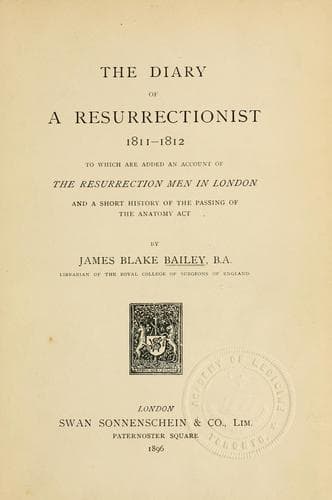
The Diary of a Resurrectionist, 1811-1812: To Which Are Added an Account of the Resurrection Men in London and a Short History of the Passing of the Anatomy ActBailey, James Blake
History
The Diary of a Resurrectionist, 1811-1812: To Which Are Added an Account of the Resurrection Men in London and a Short History of the Passing of the Anatomy Act
Bailey, James Blake
Body snatching
By no class of men was legislation more earnestly asked for than by the
teachers of anatomy; to them the system then in vogue was not only
degrading, but it meant absolute ruin.
There was at that time no property in a dead body, and a prosecution for
felony could not take place unless some portion of the grave-clothes or
coffin could be proved to have been stolen with the body. The
resurrection-men were well aware of this fact, and generally took
precaution to keep themselves out of the meshes of the law.
There had been some successful prosecutions like that of Holmes and
Williams before mentioned, but magistrates would not always convict.
In 1788 this question first came before the Court of King's Bench in the
case of Rex _v._ Lynn. The indictment charged the prisoner with entering a
certain burial-ground, and taking a coffin out of the earth, and removing
a body, which he had taken from the coffin, and carrying it away, for the
purpose of dissecting it. For the defence the following passage from Lord
Coke was quoted: "It is to be observed that in every sepulchre that hath a
monument two things are to be considered, viz., the monument, and the
sepulture or burial of the dead: the burial of the cadaver is _nullius in
bonis_, and belongs to Ecclesiastical cognizance; but as to the monument,
action is given at the common law for defacing thereof." The only Act of
Parliament which was said to bear on the subject was that of 1 Jac. I., c.
12, which made it felony to steal bodies for purposes of witchcraft. The
Court, however, held in this case of Rex _v._ Lynn that to take a body
from a burial-ground was an offence at common law, and _contra bonos
mores_. In the judgment it was stated that as the defendant might have
committed the crime through ignorance, no person having been before
punished for this offence, the Court only fined him five marks. The
reference here, to no one having been previously punished for a like
offence, refers only to the Superior Courts, as there had been convictions
at the Police Courts and the Old Bailey. Despite this decision of the
Court, prosecutions were very seldom undertaken, although Southwood
Smith[19] states that there had been fourteen convictions in England
during the year 1823. In examination before the Committee on Anatomy, in
1828, Mr. Twyford, one of the magistrates at Worship Street Police Court,
stated that he had not had more than six cases in as many years.
The following account of proceedings at Hatton Garden Police Court, in
1814, will show the difficulty of getting a conviction. In this case there
seems to have been no one to identify the bodies. It is very improbable
that in a case of this sort the authorities of burial-grounds would come
forward to give evidence, and so confess their own negligence.
"HATTON GARDEN.
Public-domain text, read in full here on John Shaqi.
Reviews
Reviews
No reviews yet
Be the first to share your thoughts on this work.
Join the Discussion
Join the discussion
Sign in to leave a comment or review.
Sign InorCreate an account