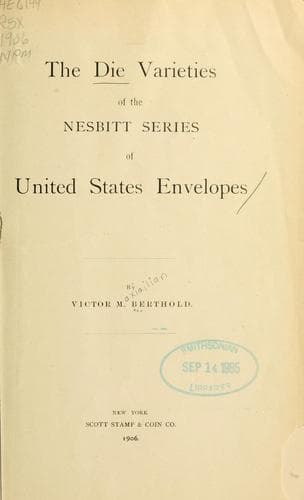
The Die Varieties of the Nesbitt Series of United States EnvelopesBerthold, Victor Maximilian
History
The Die Varieties of the Nesbitt Series of United States Envelopes
Berthold, Victor Maximilian
Postage stamps -- United States
None of the Nesbitt die varieties have given the writer so many anxious
hours and have required such prolonged study as the three cents of
1864. Indeed, the final solution of the problem of classification of
the various dies was only arrived at after more than two years
continuous research. Like the famous balancing of the egg of Columbus,
the problem, when solved, is extremely simple. Looking backward on the
long series of failures, it seems strange that the chief
characteristics have so long escaped the attention of cataloguers. The
fact, however, is patent. Even as thorough and painstaking a student as
the late Gilbert Harrison who, in 1895, chronicled, as he thought, all
of the existing die varieties of the three cents has failed to observe
the most important differences. Indeed, in the entire philatelic
literature dealing with the Nesbitt dies of 1864 there is but one
allusion to the feature which constitutes the surest means for the
identification of the die varieties, and this is only a single sentence
contained in the Historical Notes of Messrs. Tiffany, Bogert and
Rechert. It reads:--
"It is worth mentioning, however, that while dies 9, 15 and 26 (the
latter the die under consideration) all have the small bust of
Washington, there are small differences in each which show them to be
different engravings. * * In die 26 the front hair shows only five
locks and the back hair only four lines."
We shall presently see that, like the three cents, red of 1853, (Die A)
the diemakers have produced different groups of heads which, once
known, are not only an absolute means of differentiating the varieties,
but also protect the collector from acquiring a multitude of the same
die.
Although, as stated above, the die of the three cents rose equals that
of the three cents red in the use of various heads, it is, otherwise,
quite dissimilar to the first issue, as will be seen presently.
As in the varieties of the two cent dies the horizontal and vertical
dimensions of the three cents vary greatly. After careful research and
taking the advice of experienced philatelists, it was decided to adopt
only two sizes for classification: i.e.
Size A:--to include all stamps measuring horizontally 24 mm. but
not exceeding 25 mm.
Size B:--to include all stamps measuring horizontally 25-1/2 mm.
or more.
In our study of the three cents red of 1853 we noted, in addition to
the various heads, some minor differences in the spacing of the letters
forming the inscription. Referring now to the three cents of 1864, even
the unskilled eye of the layman will be struck with the surprising
changes, not only in the spacing of the letters forming a word, but,
also, in the relative position of the words to each other and their
distance from a definite point, such, for instance, as the figure "3."
The subsequent cuts well illustrate this point.
[Illustration]
Public-domain text, read in full here on John Shaqi.
Reviews
Reviews
No reviews yet
Be the first to share your thoughts on this work.
Elsewhere in the archive
Join the Discussion
Join the discussion
Sign in to leave a comment or review.
Sign InorCreate an account