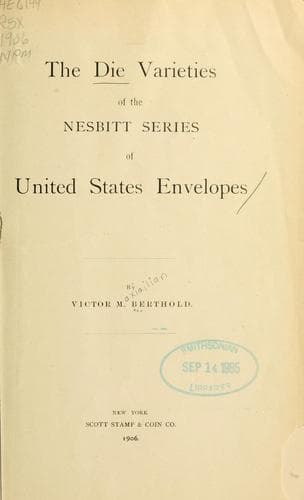
The Die Varieties of the Nesbitt Series of United States EnvelopesBerthold, Victor Maximilian
History
The Die Varieties of the Nesbitt Series of United States Envelopes
Berthold, Victor Maximilian
Postage stamps -- United States
K. 22 120 × 73 P. O. Size 1 Heads 1, 2, 3, 4 White
" 1 120 × 73 " 1 " 4 White
" 2 139 × 83 " 3 " 3 White
" 11 139 × 83 " 3 " 1, 2, 3, 4, 5 White
" 11 139 × 83 " 3 " 1, 2, 3, 4, 5 Buff
" 11 139 × 83 " 3 " 1, 2 Amber
" 11 139 × 83 " 3 " 1, 5 Buff 2nd
" 9 139 × 83 " 3 " 1, 2, 3, 4 White
" 9 139 × 83 " 3 " 1, 3, 4 Buff
" 9 139 × 83 " 3 " 1, 2 Amber
" 12 160 × 90 " 5 " 1, 2, 3, 4 White
" 12 160 × 90 " 5 " 1, 3, 4 Buff
" 12 160 × 90 " 5 " 1, 2 Amber
A similar table for the three cents, Brown shows that the following
heads exist:--
K. 21 225 × 98 Size 7 Heads 1, 2, 3, 4 White
" " " " " " 1, 2, 3, 4 Buff
" " " " " " 1, 2 Amber
The six cents, Rose and Purple comes only on heads 1 and 3.
A systematic and rational classification of the three cents (both rose
and brown) and their congener the six cents (purple and rose) is now
ready. The collector of entire envelopes will proceed as follows:--
Given a certain specimen, he first ascertains the knife, second the
color of the paper. He then decides which head is represented, and
finally ascertains whether it is an "A" or "B" die. The specialist, or
any collector who is sufficiently interested to possess the various
sub-varieties, goes a step further. Having determined the head, he
finds to which of the four classes of line measurement a given specimen
belongs. Thus the apparently bewildering number of varieties, through
the knowledge of the heads and the "U" line measurement, are brought
into perfect order, and all risk of confusion is avoided. It is evident
that, henceforth, the collector of cut squares will try to obtain at
least one specimen of the different heads of both die A and B, while
the collector of entires may go to any length to satisfy his zeal and
ambition.
The large die (Die B), measuring horizontally 25-1/2 mm. or more, is
comparatively scarce and it is found most commonly on the small
envelope, Knife 22.
THREE CENTS, ROSE.
K. 22 Heads 1, 2, 4 White
" 11 " 4 Buff
" 9 " 1, 4 White
" 9 " 1 Buff
" 12 " 2, 4 White
" 12 " 2 Amber
THREE CENTS, BROWN.
K 21 Head 1 White
" " " 1, 2 Buff
" " " 2 Amber
With the issue of the three cents, rose, the contractor, at the order
of the Post Office Department, introduced a second quality of buff
paper. This matter is of importance to all collectors and should be
duly noted.
Public-domain text, read in full here on John Shaqi.
Reviews
Reviews
No reviews yet
Be the first to share your thoughts on this work.
Elsewhere in the archive
Join the Discussion
Join the discussion
Sign in to leave a comment or review.
Sign InorCreate an account