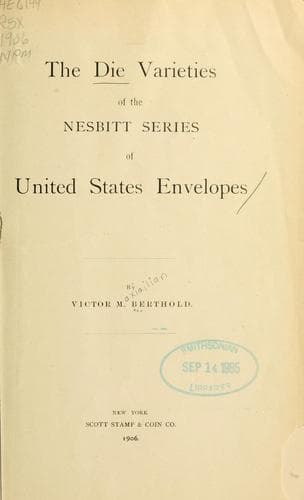
The Die Varieties of the Nesbitt Series of United States EnvelopesBerthold, Victor Maximilian
History
The Die Varieties of the Nesbitt Series of United States Envelopes
Berthold, Victor Maximilian
Postage stamps -- United States
In addition to the 3 and 6 cents, Nesbitt produced, in 1864, a new
design for the 9, 12, 18 and 30 cents, while the old design of the
former 24 and 40 cents was changed in December 1865. The main
difference between the new and the old design is that the oval band and
small circular disks are with colored background bordered by colorless
lines. The inscriptions and numerals are now colorless. The branches
have eight leaves.
Of these values no die varieties are known; but, excepting the 40 cents
pink, there are several distinct shades of each stamp.
Commencing with the Nine Cents, we have a decided lemon-yellow and an
orange; the Twelve Cents appears in dark brown and red-brown; the
Twenty-four Cents in two shades of blue; the Eighteen Cents exists in
red and dark red, and the Thirty Cents in yellow-green, dark green and
olive-green.
This concludes the Nesbitt issues of United States envelopes. His
connection with the Postal Department ceased March 31, 1870, when a new
contract was awarded to George H. Reay, of New York.
To the philatelists the Nesbitt issues are by far the most interesting
series of all the United States Postal issues and, as the years pass
on, the intrinsic value of these die varieties will increase rapidly.
Specialization is the watchword of the now growing class of collectors,
and there is no field so inviting and which will repay a student so
richly for his labor as a specialized collection of the Nesbitt issues.
What is wanted to-day is a special album for United States envelopes,
which would insure to this prominent branch of United States philately
that measure of official recognition for which collectors have long and
earnestly contended. An equally valuable aid would be the formation of
a Society of Collectors of United States envelopes. The writer
confidently expects that this suggestion will soon assume a more
tangible form.
If this series of articles has, in even the slightest degree, helped
collectors of United States envelopes to a wider knowledge and better
appreciation of these hitherto unknown die varieties, the writer will
feel well repaid for the many hours of labor. In closing, he again
asserts; "Variety is the spice of life!"
* * * * *
A REFERENCE LIST OF THE ENVELOPES OF THE SERIES OF 1864 AND 1865.
1864.
THREE CENTS, ROSE.
DIE A.
HEAD I.
No. Paper. Knife. Size. Dimensions. Variety. Remarks.
Public-domain text, read in full here on John Shaqi.
Reviews
Reviews
No reviews yet
Be the first to share your thoughts on this work.
Elsewhere in the archive
Join the Discussion
Join the discussion
Sign in to leave a comment or review.
Sign InorCreate an account