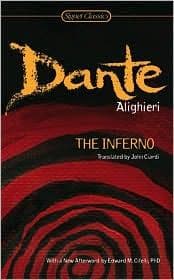
The Divine Comedy of Dante Alighieri: The InfernoDante Alighieri
ReligionJewish
The Divine Comedy of Dante Alighieri: The Inferno
Dante Alighieri
Epic poetry, Italian -- Translations into English; Hell; Italian poetry -- To 1400 -- Translations into English
History never abhors a vacuum so much as when she has to deal with the
life of a great man, and for those who must have details of Dante's
career during the nineteen years which elapsed between his banishment
and his death, the industry of his biographers has exhausted every
available hint, while some of them press into their service much that
has only the remotest bearing on their hero. If even one-half of their
suppositions were adopted, we should be forced to the conclusion that
the _Comedy_ and all the other works of his exile were composed in the
intervals of a very busy life. We have his own word for this much,
(_Convito_ i. 3,) that since he was cast forth out of Florence--in which
he would 'fain rest his wearied soul and fulfil his appointed time'--he
had been 'a pilgrim, nay, even a mendicant,' in every quarter of
Italy,[101] and had 'been held cheap by many who, because of his fame,
had looked to find him come in another guise.' But he gives no journal
of his wanderings, and, as will have been observed, says no word of any
country but Italy. Keeping close to well-ascertained facts, it seems
established that in the earlier period of his exile he sojourned with
members of the great family of the Counts Guidi,[102] and that he also
found hospitality with the Malaspini,[103] lords of the Val di Magra,
between Genoa and Lucca. At a still earlier date (August 1306) he is
found witnessing a deed in Padua. It was most probably in the same year
that Dante found Giotto there, painting the walls of the Scrovegni
Chapel, and was courteously welcomed by the artist, and taken to his
house.[104] At some time of his life he studied at Bologna: John Villani
says, during his exile.[105] Of his supposed residence in Paris, though
it is highly probable, there is a want of proof; of a visit to England,
none at all that is worth a moment's consideration. Some of his
commentators and biographers seem to think he was so short-witted that
he must have been in a place before it could occur to him to name it in
his verse.
Public-domain text, read in full here on John Shaqi.
Reviews
Reviews
No reviews yet
Be the first to share your thoughts on this work.
Join the Discussion
Join the discussion
Sign in to leave a comment or review.
Sign InorCreate an account