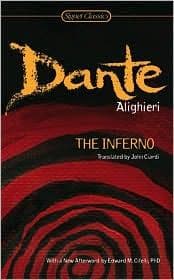
The Divine Comedy of Dante Alighieri: The InfernoDante Alighieri
ReligionJewish
The Divine Comedy of Dante Alighieri: The Inferno
Dante Alighieri
Epic poetry, Italian -- Translations into English; Hell; Italian poetry -- To 1400 -- Translations into English
What amount of intercourse he was able to maintain with Florence during
his wanderings is a matter of mere speculation, although of a more
interesting kind than that concerned with the chronology of his uneasy
travels. That he kept up at least some correspondence with his friends
is proved by the letter regarding the terms of his pardon. There is also
the well-known anecdote told by Boccaccio as to the discovery and
despatch to him of the opening Cantos of the _Inferno_--an anecdote we
may safely accept as founded on fact, although Boccaccio's informants
may have failed to note at the time what the manuscript consisted of,
and in the course of years may have magnified the importance of their
discovery. With his wife he would naturally communicate on subjects of
common interest--as, for instance, that of how best to save or recover
part of his property--and especially regarding the welfare of his sons,
of whom two are found to be with him when he acquires something like a
settlement in Verona.
It is quite credible that, as Boccaccio asserts, he would never after
his exile was once begun 'go to his wife or suffer her to join him where
he was;' although the statement is probably an extension of the fact
that she never did join him. In any case it is to make too large a use
of the words to find in them evidence, as has frequently been done, of
the unhappiness of all his married life, and of his utter estrangement
from Gemma during his banishment. The union--marriage of convenience
though it was--might be harmonious enough as long as things went
moderately well with the pair. Dante was never wealthy, but he seems to
have had his own house in Florence and small landed possessions in its
neighbourhood.[108] That before his banishment he was considerably in
debt appears to be ascertained;[109] but, without knowing the
circumstances in which he borrowed, it is impossible to be sure whether
he may not only have been making use of his credit in order to put out
part of his means to advantage in some of the numerous commercial
enterprises in which his neighbours were engaged. In any case his career
must have seemed full of promise till he was driven into banishment.
When that blow had fallen, it is easy to conceive how what if it was not
mutual affection had come to serve instead of it--esteem and
forbearance--would be changed into indifference with the lapse of months
and years of enforced separation, embittered and filled on both sides
with the mean cares of indigence, and, it may be, on Gemma's side with
the conviction that her husband had brought her with himself into
disgrace. If all that is said by Boccaccio and some of Dante's enemies
as to his temperament and behaviour were true, we could only hope that
Gemma's indifference was deep enough to save her from the pangs of
jealousy. And on the other hand, if we are to push suspicion to its
utmost length, we may find an allusion to his own experience in the
Public-domain text, read in full here on John Shaqi.
Reviews
Reviews
No reviews yet
Be the first to share your thoughts on this work.
Elsewhere in the archive
Join the Discussion
Join the discussion
Sign in to leave a comment or review.
Sign InorCreate an account