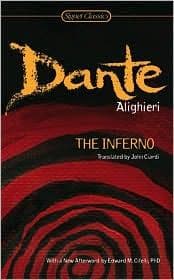
The Divine Comedy of Dante Alighieri: The InfernoDante Alighieri
ReligionJewish
The Divine Comedy of Dante Alighieri: The Inferno
Dante Alighieri
Epic poetry, Italian -- Translations into English; Hell; Italian poetry -- To 1400 -- Translations into English
At what time Dante came to Verona, and for how long he stayed, we have
no means of fixing with certainty. He himself mentions being there in
1320,[119] and it is usually supposed that his residence covered three
years previous to that date; as also that it was shared by his two sons,
Piero and Jacopo. One of these was afterwards to find a settlement at
Verona in a high legal post. Except some frivolous legends, there is no
evidence that Dante met with anything but generous treatment from Can
Grande. A passage of the _Paradiso_, written either towards the close of
the poet's residence at Verona, or after he had left it, is full of a
praise of the great Scaliger so magnificent[120] as fully to make amends
for the contemptuous mention in the _Purgatorio_ of his father and
brother.[121] To Can Grande the _Paradiso_ was dedicated by the author
in a long epistle containing an exposition of how the first Canto of
that Cantica, and, by implication, the whole of the poem, is to be
interpreted. The letter is full of gratitude for favours already
received, and of expectation of others yet to come. From the terms of
the dedication it has been assumed that ere it was made the whole of the
_Paradiso_ was written, and that Dante praises the lord of Verona after
a long experience of his bounty.[122]
Whether owing to the restlessness of an exile, or to some prospect of
attaining a state of greater ease or of having the command of more
congenial society, we cannot tell; but from the splendid court of Can
Grande he moved down into Romagna, to Ravenna, the city which of all in
Italy would now be fixed upon by the traveller as the fittest place for
a man of genius, weighed down by infinite sorrows, to close his days in
and find a tomb. Some writers on the life of Dante will have it that in
Ravenna he spent the greater part of his exile, and that when he is
found elsewhere--in Lucca or Verona--he is only on a temporary absence
from his permanent home.[123] But this conclusion requires some facts to
be ignored, and others unduly dwelt on. In any case his patron there,
during at least the last year or two of his life, was Guido Novello of
Polenta, lord of Ravenna, the nephew of her who above all the persons of
the _Comedy_ lives in the hearts of its readers.
Public-domain text, read in full here on John Shaqi.
Reviews
Reviews
No reviews yet
Be the first to share your thoughts on this work.
Elsewhere in the archive
Join the Discussion
Join the discussion
Sign in to leave a comment or review.
Sign InorCreate an account