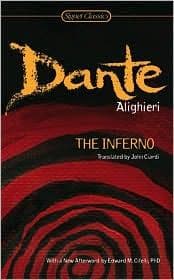
The Divine Comedy of Dante Alighieri: The InfernoDante Alighieri
ReligionJewish
The Divine Comedy of Dante Alighieri: The Inferno
Dante Alighieri
Epic poetry, Italian -- Translations into English; Hell; Italian poetry -- To 1400 -- Translations into English
Most of the material for forming a judgment of how Dante stood affected
to the religious beliefs of his time is to be gathered from the
_Comedy_, and the place for considering it would rather be in an essay
on that work than in a sketch of his life which necessity compels to be
swift. A few words may however be here devoted to the subject, as it is
one with some bearing on the manner in which he would be regarded by
those around him, and through that on the tenor of his life. That Dante
conformed to Church observances, and, except with a few malevolent
critics, bore the reputation of a good Catholic, there can be no doubt.
It was as a politician and not as a heretic that he suffered
persecution; and when he died he was buried in great honour within the
Franciscan Church at Ravenna. Some few years after his death, it is
true, his _De Monarchia_ was burned as heretical by orders of the Papal
Legate in Lombardy, who would gladly, if he could, have had the bones of
the author exhumed to share the fate of his book. But all this was only
because the partisans of Lewis of Bavaria were making political capital
out of the treatise.
Attempts have been made to demonstrate that in spite of his outward
conformity Dante was an unbeliever at heart, and that the _Comedy_ is
devoted to the promulgation of a Ghibeline heresy--of which, we may be
sure, no Ghibeline ever heard--and to the overthrow of all that the
author professed most devoutly to believe.[130] Other critics of a more
sober temper in speculation would find in him a Catholic who held the
Catholic beliefs with the same slack grasp as the teaching of Luther was
held by Lessing or Goethe.[131] But this is surely to misread the
_Comedy_, which is steeped from beginning to end in a spirit of the
warmest faith in the great Christian doctrines. It was no mere
intellectual perception of these that Dante had--or professed to
have--for when in Paradise he has satisfied Saint Peter of his being
possessed of a just conception of the nature of faith, and is next asked
if, besides knowing what is the alloy of the coin and the weight of it,
he has it in his own purse, he answers boldly, 'Yea, and so shining and
round that of a surety it has the lawful stamp.'[132] And further on,
when required to declare in what he believes, nothing against the
fulness of his creed is to be inferred from the fact that he stops short
after pronouncing his belief in the existence of God and in the Trinity.
This article he gives as implying all the others; it is 'the spark which
spreads out into a vivid flame.'[133]
Public-domain text, read in full here on John Shaqi.
Reviews
Reviews
No reviews yet
Be the first to share your thoughts on this work.
Elsewhere in the archive
Join the Discussion
Join the discussion
Sign in to leave a comment or review.
Sign InorCreate an account