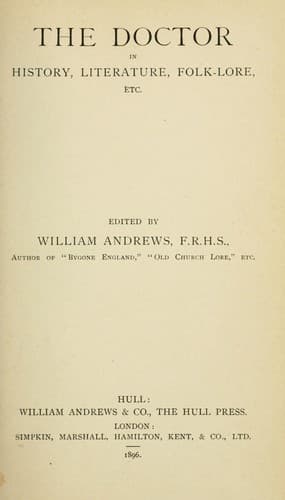
The Doctor in History, Literature, Folk-Lore, Etc.
History
The Doctor in History, Literature, Folk-Lore, Etc.
Literature and medicine; Physicians; Physicians in literature
In 1561 there was issued "A newe booke conteyninge an exortacion to the
sicke." The tract ends with the following parody on the nostrums current
for the cure of the pestilence: "Take a pond of good hard penaunce, and
washe it wel with the water of your eyes, and let it ly a good whyle at
youre hert. Take also of the best fyne fayth, hope, charyte yt you can
get, a like quantite of al mixed together, your soule even full, and use
this confection every day in your lyfe, whiles the plages of God
reigneth. Then, take both your handes ful of good workes commaunded of
God, and kepe them close in a clene conscience from the duste of vayne
glory, and ever as you are able and se necessite so to use them. This
medicine was found wryten in an olde byble boke, and it hath been
practised and proved true of mani, both men and women" (Collier's _Bib.
Account_, i. 74).
The wealthy, on an outbreak of the plague, fled from the infected city, as
we may learn from Boccaccio, and from Miles Coverdale's translation of
Osiander's sermon, "How and whether a Christian man ought to flye the
horrible plage of the pestilence," which appeared in 1537.
During the plague of London, in 1603, the physicians are asserted by
Dekker to have "hid their synodical heads," but this is at all events not
wholly true. Thomas Lodge, the poet, was also a graduate in medicine, and
in his "Treatise on the Plague"--not the only one published in relation to
this epidemic--we are told of his experiences of the plague-stricken city.
He gives some good advice in relation to the sanitary measures to be taken
for the prevention of the plague.
The nature of the regulations devised in the Tudor times to ward off
infection may be gathered from the rules laid down at Chester in November,
1574, when
"the right Worshipful Sir John Sauage, Knight, maior of the City of
Chester had consideracion of the present state of the said cite
somewhat visited with what is called the plage, and divisinge the best
meanes and orderlie waies he can, with [the advice] of his Bretheren
the alderman, Justices of peace within the citie aforesaid (through
the goodness of God) to avoid the same hath with such advice, sett
forth ordained and appointed (amongst other) the points, articles,
clauses, and orders folowing, which he willeth and commandeth all
persons to observe and kepe, upon the severall pains theirin
contayned:
"Imprimis. That no person nor persons who are or shalbe visited with
the said sickness, or any other who shall be of there company, shall
go abrode out of there houses without license of the alderman of the
ward such persons inhabite, And that every person soe licensed to
beare openlie in their hands ... three quarters long ... ense ...
shall goe abrode out of the ... upon paine that eny person doynge the
contrary to be furthwith expulsed out of the said citie.
Public-domain text, read in full here on John Shaqi.
Reviews
Reviews
No reviews yet
Be the first to share your thoughts on this work.
Elsewhere in the archive
Join the Discussion
Join the discussion
Sign in to leave a comment or review.
Sign InorCreate an account