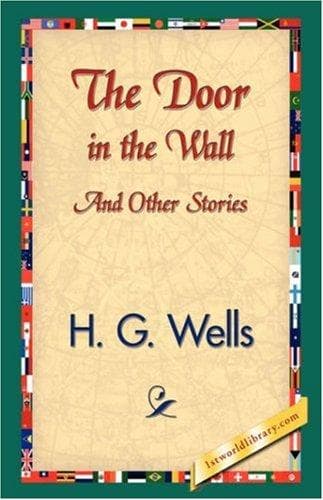
The Door in the Wall, and Other StoriesWells, H. G. (Herbert George)
Science
The Door in the Wall, and Other Stories
Wells, H. G. (Herbert George)
Fantasy fiction, English; Science fiction, English; Short stories
Now, a year or so ago, I had occupied my leisure in taking a London
science degree, so that I have a smattering of physics and mineralogy.
The thing was not unlike an uncut diamond of the darker sort, though
far too large, being almost as big as the top of my thumb. I took it,
and saw it had the form of a regular octahedron, with the curved faces
peculiar to the most precious of minerals. I took out my penknife and
tried to scratch it—vainly. Leaning forward towards the gas-lamp, I
tried the thing on my watch-glass, and scored a white line across that
with the greatest ease.
I looked at my interlocutor with rising curiosity. “It certainly is
rather like a diamond. But, if so, it is a Behemoth of diamonds. Where
did you get it?”
“I tell you I made it,” he said. “Give it back to me.”
He replaced it hastily and buttoned his jacket. “I will sell it you for
one hundred pounds,” he suddenly whispered eagerly. With that my
suspicions returned. The thing might, after all, be merely a lump of
that almost equally hard substance, corundum, with an accidental
resemblance in shape to the diamond. Or if it was a diamond, how came
he by it, and why should he offer it at a hundred pounds?
We looked into one another’s eyes. He seemed eager, but honestly eager.
At that moment I believed it was a diamond he was trying to sell. Yet I
am a poor man, a hundred pounds would leave a visible gap in my
fortunes and no sane man would buy a diamond by gaslight from a ragged
tramp on his personal warranty only. Still, a diamond that size
conjured up a vision of many thousands of pounds. Then, thought I, such
a stone could scarcely exist without being mentioned in every book on
gems, and again I called to mind the stories of contraband and
light-fingered Kaffirs at the Cape. I put the question of purchase on
one side.
“How did you get it?” said I.
“I made it.”
I had heard something of Moissan, but I knew his artificial diamonds
were very small. I shook my head.
“You seem to know something of this kind of thing. I will tell you a
little about myself. Perhaps then you may think better of the
purchase.” He turned round with his back to the river, and put his
hands in his pockets. He sighed. “I know you will not believe me.”
“Diamonds,” he began—and as he spoke his voice lost its faint flavour
of the tramp and assumed something of the easy tone of an educated
man—“are to be made by throwing carbon out of combination in a suitable
flux and under a suitable pressure; the carbon crystallises out, not as
black-lead or charcoal-powder, but as small diamonds. So much has been
known to chemists for years, but no one yet had hit upon exactly the
right flux in which to melt up the carbon, or exactly the right
pressure for the best results. Consequently the diamonds made by
chemists are small and dark, and worthless as jewels. Now I, you know,
have given up my life to this problem—given my life to it.
Public-domain text, read in full here on John Shaqi.
Reviews
Reviews
No reviews yet
Be the first to share your thoughts on this work.
Elsewhere in the archive
Join the Discussion
Join the discussion
Sign in to leave a comment or review.
Sign InorCreate an account