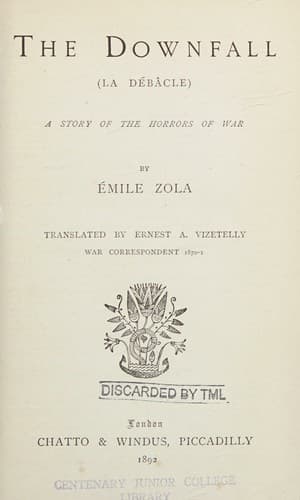
The Downfall (La Débâcle): A Story of the Horrors of WarZola, Émile
General
The Downfall (La Débâcle): A Story of the Horrors of War
Zola, Émile
Franco-Prussian War, 1870-1871 -- Fiction
Maurice's feet caused him intense suffering. They were swelling in his
coarse hard shoes, to which he was not habituated. He was far from
robust, and though he had rid himself of his knapsack he could still
feel a smarting sore on his spine, the unbearable hurt occasioned by
his burden. Now, too, the mere weight of his gun, no matter how he
carried it, made his breath come short and fast. But he was yet more
distressed by the moral agony he experienced, for he was in one of
those crises of despair to which he was subject. All at once, without
possible resistance on his part, he would see his will-power collapse,
and give way to evil instincts and self-abandonment, that subsequently
made him sob with very shame. His errors in Paris had never been
aught but the madness of 'his other self' as he expressed it, of the
weak-minded fellow, capable of any degraded action, that he became in
moments of low-spiritedness. And since he had been dragging himself
along, under the overpowering sun, in this retreat which resembled
a rout, he had become but a unit of the dawdling, disbanded flock
spread over the roads. It was the countershock of the defeat, of the
thunderbolt that had fallen leagues away, and the echo of which was
following close at the heels of these panic-stricken men who fled
without having seen an enemy. What could be hoped for now? Was it not
all over? They were beaten, and there was nothing to do but to lie down
and die.
'All the same,' shouted Loubet with that market boy's laugh of his;
'all the same we are not going to Berlin.'
'To Berlin! to Berlin!' Maurice again heard the cry bellowed forth
by the swarming crowd on the Boulevards during that night of mad
enthusiasm that had determined him to enlist. But the wind had changed
into a tempestuous squall, there had been a terrible veering, and
the very temperament of the French race was symbolised by the heated
confidence which at the first reverse had suddenly collapsed into the
despair now galloping among these vagrant, dispersed soldiers who were
vanquished without having fought.
'This popgun of mine jolly well hurts my arms,' resumed Loubet, as
he again changed his chassepot from one shoulder to the other. 'A
nice toy, indeed, to carry about with one.' And then alluding to the
money he had received as a substitute[9] he added: 'All the same,
only fifteen hundred francs for such a trade as this--it's a regular
swindle. That rich bloke whose place I've took must be smoking some
nice pipes by his fireside, while I'm off to get my head cracked.'
'I had finished my time,' growled Chouteau, 'and I was just about to
slope, but on account of this war they made me stay. Ah! what cursed
bad luck to stumble into such a swinish business as this.'
He was balancing his rifle with a feverish hand, and suddenly he threw
it, with all his strength, over a hedge. 'There,' said he, 'that's the
place for the dirty thing.'
Public-domain text, read in full here on John Shaqi.
Reviews
Reviews
No reviews yet
Be the first to share your thoughts on this work.
Join the Discussion
Join the discussion
Sign in to leave a comment or review.
Sign InorCreate an account