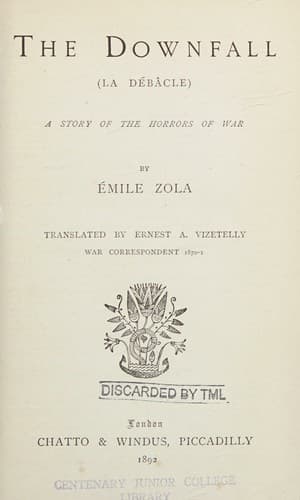
The Downfall (La Débâcle): A Story of the Horrors of WarZola, Émile
General
The Downfall (La Débâcle): A Story of the Horrors of War
Zola, Émile
Franco-Prussian War, 1870-1871 -- Fiction
Just then an unforeseen meeting put the finishing touch to Maurice's
rage. A dull, continuous rumbling was heard from afar; it was the
reserve artillery, which had been the last to start, and the first
detachment of which suddenly debouched round a turn of the road,
the laggard linesmen having barely time to throw themselves into
the fields. There was an entire artillery regiment of six squadrons
marching in column, the colonel in the centre and each officer in
his place, and they all clattered along at equal, carefully observed
distances, each accompanied by its caisson, horses, and men. And in
the fifth squadron Maurice recognised his cousin Honoré's gun. The
quartermaster was there, proudly erect on his horse, to the left of
the front driver, Adolphe, a stalwart, fair-complexioned man, who
bestrode a sturdy chestnut, which admirably matched the off-horse
trotting beside it; whilst Adolphe's chum, Louis, the gunner, a dark
little fellow, would be seen among the six men seated in pairs on the
ammunition boxes. They all seemed to have grown taller to Maurice, who
had become acquainted with them at the camp, and the gun, drawn by its
four horses and followed by its caisson, to which six other horses
were harnessed, appeared to him as dazzling as a sun, well groomed and
furbished, idolised by all its people, man and beast, who clung to it
as it were with the discipline and attachment of a gallant family; and
fearfully was Maurice's suffering increased when he saw his cousin
Honoré dart a contemptuous glance at all the laggards, and then look
quite stupefied on perceiving him among this flock of unarmed men.
The defiling was nearly over already. The train of the batteries, the
ammunition and forage waggons, the field smithies passed by; and then
in a last cloud of dust came the spare men and horses, who vanished
from sight at another bend of the road, amid the gradually subsiding
clatter of wheels and hoofs.
'Pooh!' said Loubet, 'it's easy enough to swagger when you travel about
in a carriage.'
The staff had found Altkirch unoccupied. There were no Prussians there
as yet. Still fearing, however, that he was being pursued, and that the
enemy might appear at any moment, General Douay had determined upon
pushing on to Dannemarie, where the first detachments only arrived at
five in the evening. Eight o'clock had struck, and night was gathering
in, when the regiments, in frightful confusion and reduced to half
their strength, commenced preparations for bivouacking. The men were
quite exhausted, sinking both with hunger and fatigue. The laggards,
the lamentable and interminable tag-rag and bobtail of the army, the
cripples and mutineers scattered along the roads, continued arriving,
now one by one, now in little bands, until ten o'clock, and had to
search in the darkness for their companies which they could not find.
Public-domain text, read in full here on John Shaqi.
Reviews
Reviews
No reviews yet
Be the first to share your thoughts on this work.
Elsewhere in the archive
Join the Discussion
Join the discussion
Sign in to leave a comment or review.
Sign InorCreate an account